
1-805-484-2992
Quotes - Engineering - SalesThree material decisions on every sanitary order
The product-contact metal, the elastomers, and the documentation are decided separately and they are each worth a page. The metal question is nearly always 304L or 316L, with a higher alloy only where chlorides or an aggressive cleaning chemistry demand it. The elastomer question is which compound survives the CIP chemistry and the SIP temperature while staying compliant for food or pharmaceutical contact. The documentation question is what the plant's QA program needs to see, from a simple material test report to a full turnover package.
Sanitary duty is easier on the metal than most chemical service and harder on the gaskets. Milk, juice, wort and purified water are mild. The cleaning cycle is not: hot caustic, acid, sometimes chlorine, and steam, several hundred times a year. Materials are chosen for the cleaning program first and the product second.
The three pages below give the grades, the compounds and the certificates. This page gives the reasoning.
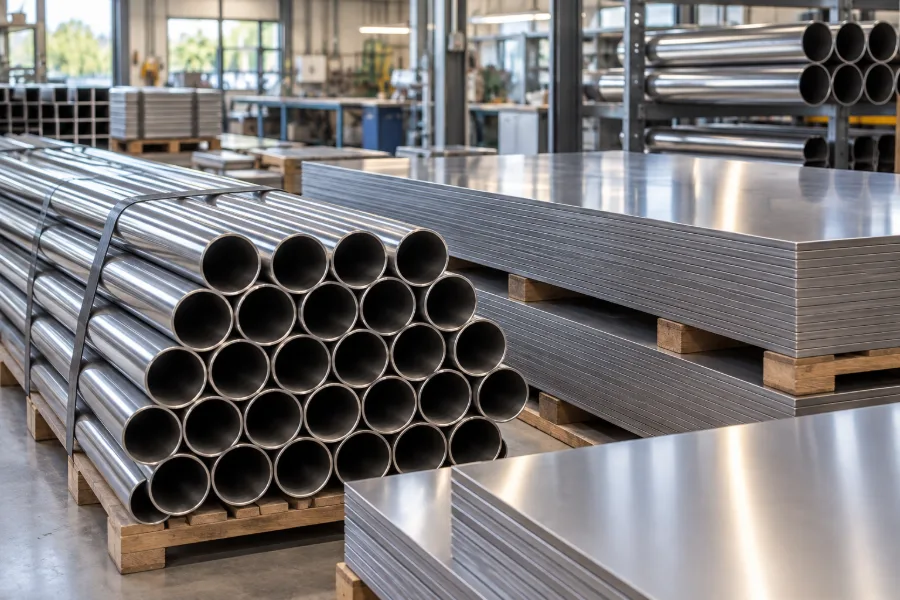
304L & 316L
- 304L: milk, juice, wort, sugar, plant water; the food default
- 316L: brine, tomato, chlorinated sanitizer, pharma water; 2 to 3 percent molybdenum
- Sulfur-controlled 316L for orbital welding on BPE work
- Sanitary tube to ASTM A270; pressure tube to A269 or A249
Higher alloys
- 2205 duplex for high chlorides and stress corrosion resistance
- AL-6XN (6 percent Mo) for hot chloride and seawater-grade duty
- Hastelloy C-22 for aggressive CIP, hot acids, mixed oxidizers
- Titanium for chlorinated seawater or hot brine cooling
Gaskets & Elastomers
- EPDM for water, caustic and most CIP; the sanitary default
- FKM (fluoroelastomer) for fats, oils and flavor solvents that swell EPDM
- Silicone for the highest steam temperatures; softer, shorter life
- PTFE and PTFE-enveloped where chemistry defeats the elastomers
Certs & Traceability
- MTRs to EN 10204 3.1 for every wetted heat
- Heat numbers on the weld map, so any joint traces to its mill cert
- Surface finish, passivation and hydrotest reports as deliverables
- Turnover package assembled for pharma validation




Choosing the stainless grade
304L is the correct choice for most food and dairy product contact. It resists the product, the caustic and the nitric or phosphoric acid without difficulty and costs less than 316L. What it does not resist is chloride: hot brine, tomato and citrus concentrates, pickle liquor, and any sanitizer built on hypochlorite. Chloride pitting starts at crevices and welds, and once a pit is through a tube wall the unit is scrap. If chlorides are present at any step, product or cleaning, 316L is the floor, and its pitting resistance equivalent number (PREN) of about 24 against 304L's 19 is the reason.
Pharmaceutical water is a different case. WFI at 80 C is not corrosive in the usual sense but it rouges 304L quickly, and BPE work is 316L by convention and by nearly every specification.
When to go higher
Above 316L the choice is driven by chloride level and temperature together. 2205 duplex, with a PREN around 35, handles hot brines and gives roughly twice the yield strength, which means thinner walls. AL-6XN at PREN 45 or more handles seawater and hot concentrated brines. Hastelloy C-22 is for aggressive cleaning chemistry that combines acids and oxidizers, rarely needed on food but seen in some biotech kill systems. Each step up roughly doubles the material cost of the wetted parts, and none of them is needed for milk.
Elastomers are the wear item
The gasket compound is chosen for the cleaning program, then checked against the product. EPDM handles hot water, caustic, and nitric or phosphoric acid and is the default in dairy, beverage and pharma water. It swells in fats and oils, which is why FKM takes over on edible oil, cream at high fat, and flavor solvents. Silicone tolerates the highest SIP temperatures but is soft and abrades in clamp joints. All of them are supplied in compounds compliant with FDA 21 CFR 177, and USP Class VI compounds are used where the pharmaceutical specification asks for it.
Ask for the paper
Every wetted heat of metal should arrive with a mill test report and every product-contact gasket with its compound compliance statement. On pharmaceutical work the fabricator ties them together on a weld map so an auditor can pick any joint and trace it to its certificates. Call and talk it through with an engineer: 1-805-484-2992
Common FAQs
It resists chlorides better and rouges more slowly. On milk, juice and wort with a chlorine-free CIP, 304L performs identically and costs less. Buy 316L for a reason, not by default.
Low carbon, 0.03 percent maximum. It keeps chromium carbides from forming at weld heat-affected zones, which would otherwise leave a band that corrodes first. Sanitary tube and fittings are always L grades because they are welded.
Yes, and it usually is. The shell and utility side can be 304 or 304L while the product side is 316L, or the shell can be carbon steel on some industrial-utility duties, as long as the sanitary exterior requirement is met.
Only where the specification says so, which is common on injectable product and WFI. FDA 21 CFR 177 compliance is the requirement for food and is met by the standard sanitary compounds.
A material test report, also called a mill cert, issued by the mill for one heat of metal. It lists the chemistry and mechanical test results. EN 10204 type 3.1 is the certificate format most specifications name.
Related
Design & Fabrication
Sanitary Standards
3-A, ASME BPE and food-grade drainable: what each one requires, what it costs, and how to pick the right one.
+ Learn More
Design & Fabrication
Product-Contact Design
The four details that decide whether the product side cleans, drains and stays uncontaminated.
+ Learn More
Design & Fabrication
Codes & Certification
Pressure codes, registration numbers and sanitary marks: what each is, who requires it, and where it goes.
+ Learn More