
1-805-484-2992
Quotes - Engineering - SalesThe standard plate unit for water-like product
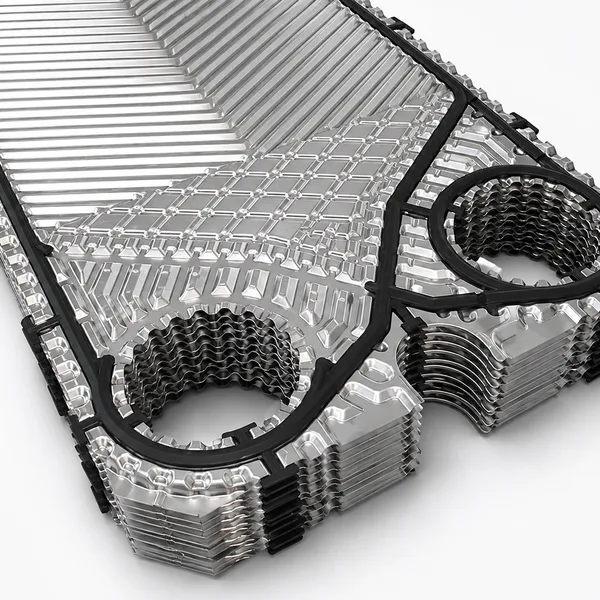
A gasketed plate exchanger is a stack of pressed stainless plates, each carrying an elastomer gasket around its edge and around its ports. Clamped in the frame, the gaskets form alternating product and utility channels a tenth of an inch or so wide. The chevron corrugation pressed into each plate throws the fluid into turbulence at velocities that would leave a tube in laminar flow, which is where the high coefficients and the tight approach come from.
For milk, cream, juice, beer, wort, liquid egg, plant-based beverages, sugar solutions and clean water, this is the first construction to consider. The plates are thin, the metal is cheap per square foot compared with tubes, and the same frame holds heating, regeneration and cooling sections separated by connection plates.
The plate exchanger is also the easiest sanitary unit to change your mind about: more capacity is more plates on the same bars, a different product is a different plate pattern in the same frame, and a worn gasket set is an afternoon's work.
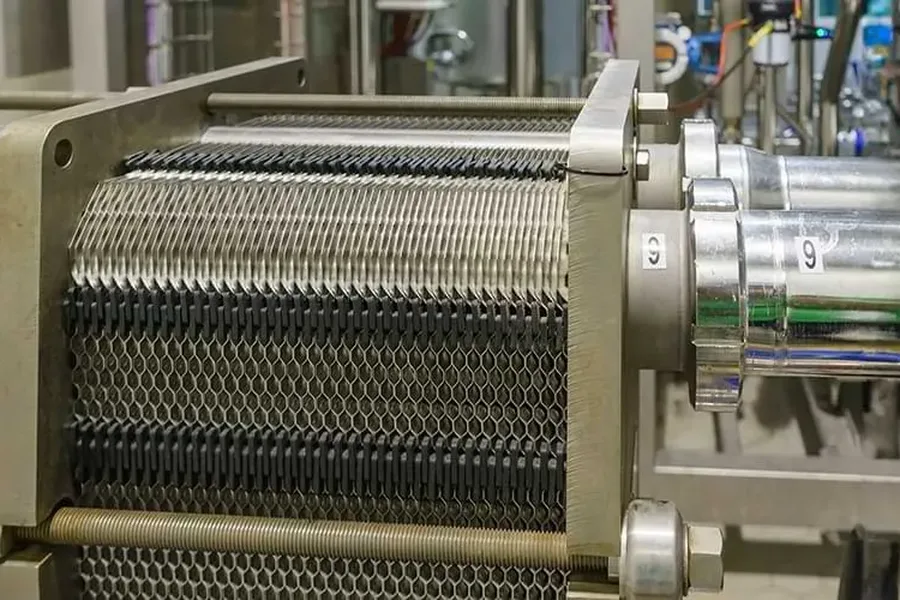
Nine-tenths of the heat in a pasteurizer never leaves the plate pack. Regeneration is why gasketed plates own HTST.
85 to 90 percent regeneration on milk and juice with a 2 to 3 F approach.
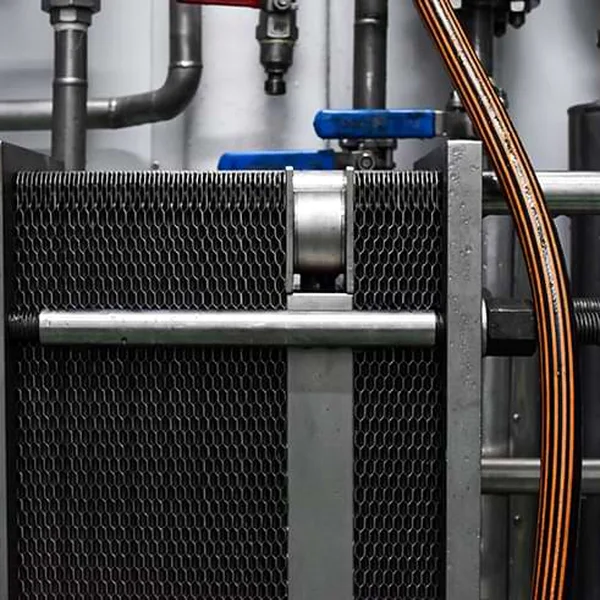
Regeneration that carries the pasteurizer
- Heating, regeneration and cooling sections share one frame
- Pasteurized side held above raw side pressure
- Connection plates carry ports between sections
- Close approach from turbulence in thin channels
- High and low angle plates tune pressure drop
A frame that changes with you
- Add plates on spare bar length for more capacity
- Clip-on gaskets replaced on the plant floor
- Every plate swings out for inspection of both faces
- CIP channel velocity checked at sizing, not assumed
- EPDM, nitrile or FKM matched to product and CIP
Order It With




Gasketed plate, typical sanitary build
The typical gasketed plate build is listed here, from plate material and gap to the ports and codes. Anything your specification changes is quoted as stated, so send your requirements with the request.
| Feature | Detail |
| Plate material | 304L standard; 316L for chlorides, wine, brine, acid sauces and pharma |
| Plate thickness | 0.5 to 0.8 mm typical; heavier for higher design pressure |
| Plate area | 0.5 to 51 sq ft per plate, small units to large pasteurizers |
| Channel gap | Roughly 0.1" to 0.15" on standard chevron pressings |
| Gasket compounds | EPDM standard; nitrile for fats and oils; FKM for higher temperature and chemistry |
| Gasket attachment | Clip-on or glued; clip-on preferred for field replacement |
| Ports | Tri-clamp studded ports 1" to 6"; sanitary flanges above that |
| Design pressure | 150 psig typical; higher with heavier frames |
| Design temperature | Generally 250 F with EPDM; CIP at 160 to 180 F routine |
| Codes | 3-A plate exchanger standard, ASME U-stamp frame, PED, CRN as specified |
Sizing and running a sanitary gasketed plate exchanger
Multi-section frames for pasteurization
An HTST frame usually holds three sections. Raw product enters the regeneration section and picks up heat from pasteurized product going the other way; it then enters the heating section where hot water or low-pressure steam brings it to the hold temperature, 161 F for milk and higher for many juices; after the holding tube it returns through regeneration and finally into the cooling section against chilled water or glycol. Connection plates between sections carry the intermediate ports. Pressure on the pasteurized side is kept higher than on the raw side in regeneration so any gasket weep flows from safe to raw, and the booster pump and pressure switches that enforce this are part of the system design.
Plate pattern, theta and pressure drop
Chevron plates are pressed at a high or low angle, and mixing high- and low-angle plates in the same pack tunes the pressure drop against heat transfer. A pack built entirely of high-angle plates gives the highest coefficient and the highest pressure drop; low-angle plates trade coefficient for flow. The sizing software selects the mix so the duty is met with the available pump head, and the same tool checks the CIP case, where channel velocity should be at least 1.5 times the product velocity so the corrugation valleys are scrubbed. A pack that meets the thermal duty but cannot reach CIP velocity is undersized for a sanitary plant.
- High-angle plates: maximum coefficient, highest pressure drop
- Low-angle plates: lower pressure drop, more area
- Mixed packs tuned to available pump head
- CIP channel velocity checked, not assumed
Gaskets: compound, attachment and life
EPDM is the default sanitary compound, comfortable with hot water, caustic and nitric or phosphoric acid CIP, and fine with steam at a few psig for sterilization. Nitrile is chosen where the product carries fats or oils that swell EPDM, such as cream, liquid egg and edible oil. FKM extends temperature and chemical resistance where CIP chemistry is aggressive. All compounds are food-grade and documented to FDA and 3-A material requirements. Clip-on gaskets are strongly preferred over glued because a plate can be re-gasketed on the plant floor without solvents or curing time. Gasket life in HTST service is commonly several years; plants schedule replacement with the plate inspection rather than waiting for a weep.
Inspection, expansion and what to watch
With the tie bolts backed off and the movable frame plate slid back, every plate can be swung out and both faces examined. Plants look for gasket set, for erosion at the port throats, and for any pinhole found by dye penetrant on a plate pulled for the purpose. Expansion is straightforward: order the frame with spare bar length and add plates later, keeping the same pattern and re-checking pressure drop. The one caution is that a plate pack sized for a water-like product should not be re-tasked to a viscous one by adding plates; that duty needs a different pattern or a different construction.
A gasketed plate exchanger sized with regeneration in mind, gasketed for the product and framed with room to grow is the most economical sanitary heat transfer available for clean liquids. Call and talk it through with an engineer: 1-805-484-2992
Common FAQs
Milk, cream, whey, juice without heavy pulp, beer and wort after trub removal, liquid egg, sugar syrups under a few hundred centipoise, plant-based beverages, CIP solution and any clean water. Product with pulp, seeds or fibers moves to wide-gap plates or tube-in-tube.
85 to 90 percent on milk and clear juice is standard practice. Higher is possible with more plate area but the added plates give diminishing energy savings; the sizing balances plate count against utility cost.
Only at low pressure, within the gasket temperature rating, and it is usually avoided in favor of a hot water loop heated by a separate steam-to-water unit. Hot water gives closer control of the hold temperature and much longer gasket life.
Several years is common in HTST and beverage service with EPDM at CIP temperatures. Higher process temperatures, aggressive CIP chemistry or fatty products shorten it. Clip-on gaskets are replaced plate by plate with the pack open.
Adding plates within the frame's rated plate count and tightening dimension does not change the pressure rating. The thermal and hydraulic performance is re-calculated so the pump and controls still match.
Yes. Vertical plates with corner ports drain to the bottom port; there are no pockets. The 3-A plate exchanger standard also addresses gasket material, plate finish and connection design, all of which the sanitary build meets.
Related
Sanitary Exchangers
Double-Wall Plate
Two plates where one used to be, a vented gap between them, and no way for glycol to reach product.
+ Learn More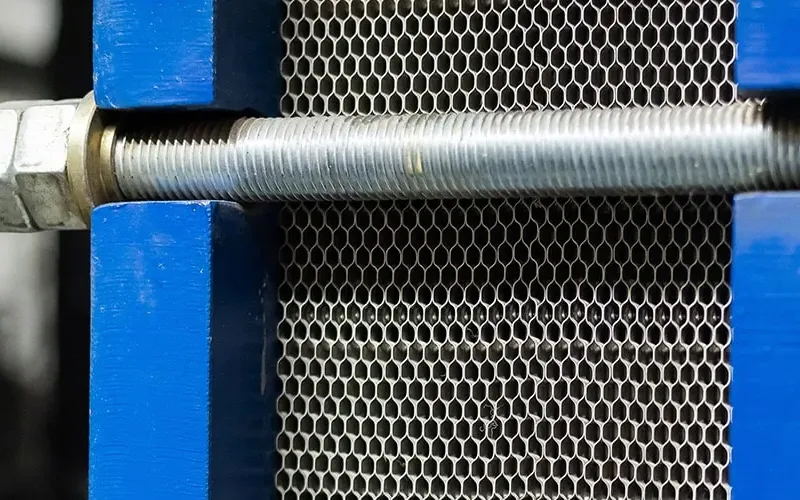
Sanitary Exchangers
Wide-Gap Plate
Plate-exchanger economics for product that would plug a standard chevron pack.
+ Learn More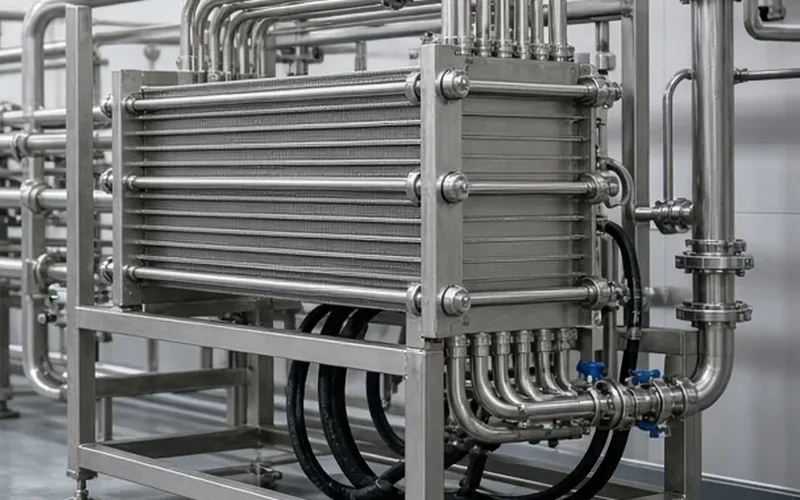
Sanitary Exchangers
Plate & Frame
Close approach, regeneration and a pack that opens for inspection: the pasteurizer's construction.
+ Learn More