
1-805-484-2992
Quotes - Engineering - SalesHeating and cooling added to a tank without cutting it
Immersion assemblies are double-embossed panels, pillowed on both faces, suspended in the product from the top of the tank on a stainless hanger with the utility connections brought out above the liquid line. The plate is wetted on both sides, so every square foot of panel is working surface, and the product moves past it by natural convection or by the tank agitator. A single plate or a set of plates on a common manifold is sized to the pull-down or hold duty and lowered in through the manway or a top nozzle.
Clamp-on panels take the other route. A single-embossed panel is formed to the tank radius and bolted to lugs welded on the outside of the vessel, with heat-transfer mastic filling the gap between the flat face of the panel and the wall. Nothing touches the product and the tank interior is unchanged, which is the arrangement of choice when the vessel is already certified or the product will not tolerate anything inside it.
Bank assemblies are the third form: parallel panels on a fixed pitch, the product flowing between them in a trough or a housing. That is the construction behind hydrocoolers, ice banks and falling-film chillers, where a large volume has to be pulled down fast and the plates double as the ice-building surface.
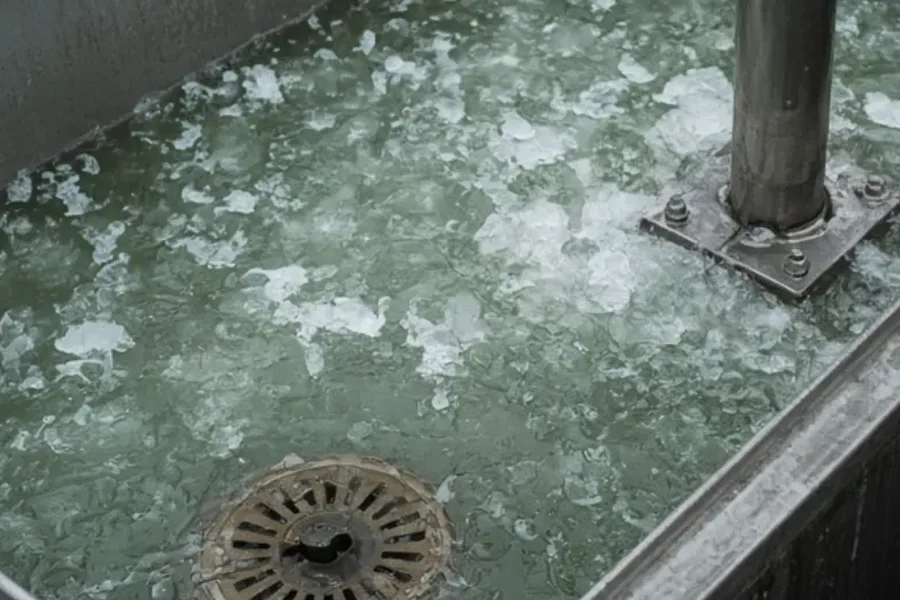
The tank was built last year, it was never jacketed, and the product now needs to be cold. An immersion plate is the answer that does not involve a cutting torch.
Retrofit heating and cooling for sanitary tanks, troughs and ice banks.
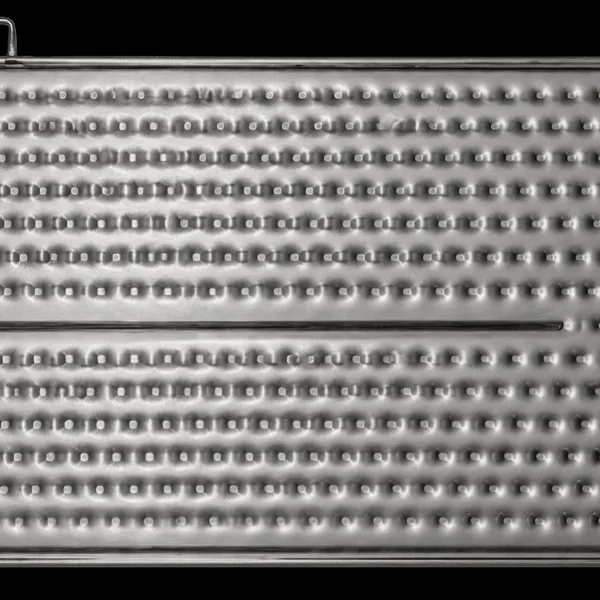
Cooling added to a tank you own
- Lowered through the manway or a top nozzle
- Both faces wet, every square foot working
- Utility connections exit above the liquid level
- Hung from a hanger bar, no jacket required
- Agitator raises the coefficient several times
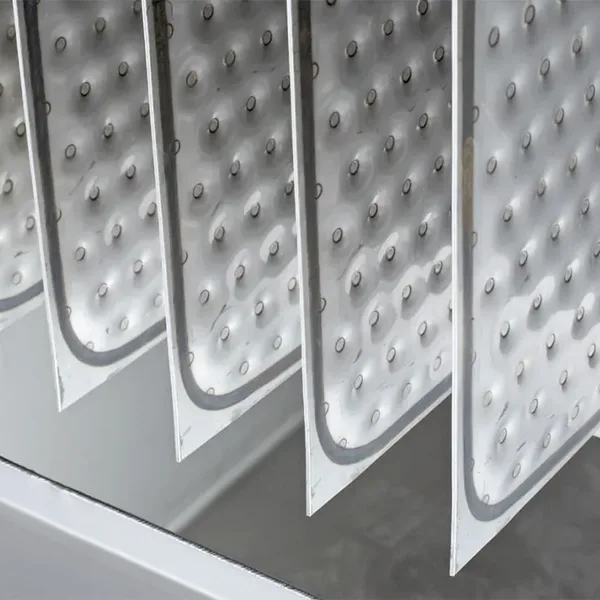
Clamp-on and bank options
- Clamp-on panel leaves the tank interior untouched
- Mastic fills the gap between panel and wall
- Ice bank plate pitch set by ice thickness
- Hanger supports sized for plate weight and ice
- Falling-film banks give a short residence time
Specify It With




Immersion, clamp-on and bank assemblies, typical build
The rows describe the typical build for immersion, clamp-on and bank assemblies, from panel type to the pitch of the bank. Compare them with your tank and send its size, product and duty with the quote request.
| Feature | Detail |
| Panel type | Double-embossed for immersion and banks; single-embossed for clamp-on |
| Panel size | Up to about 60" x 240" per panel; manifolded sets for larger surface |
| Materials | 304L standard, 316L for chlorides or acid product; titanium on request |
| Product-side finish | Mill or 2B on immersion plates; polished to a stated Ra when specified |
| Hanger and supports | Stainless hanger bar and lugs, sized to plate weight plus ice load |
| Utility connections | Tri-clamp, NPT or flanged, brought above the liquid line |
| Utility media | Chilled water, propylene glycol, hot water, steam, ammonia or CO2 DX |
| Design rating | Per material, gauge and weld pattern; 100 to 150 psig typical, higher on request |
| Clamp-on attachment | Bolted to vessel lugs with heat-transfer mastic between panel and wall |
| Bank pitch | Set by ice thickness or product flow gap, commonly 2" to 6" between plates |
Sizing and applying immersion plates
Pull-down duty and natural convection
An immersion plate in an unagitated tank is a natural-convection surface, and the coefficient on the product side is set by the temperature difference and the fluid, not by a pump. For water-like product against a glycol-cooled plate that coefficient is modest, and the sizing is done on it honestly rather than assuming forced flow. What makes the arrangement work is that the plate surface is large and cheap per square foot, so the plate is simply made big enough. A tank agitator, or a small recirculation pump aimed along the plate, raises the coefficient several times and is often the difference between a plate that fits the manway and one that does not. Pull-down time is then a matter of stored heat in the batch divided by what the plate can remove per hour, and the plate is sized to the time the process wants, not to a rule of thumb.
Ice banks and falling film
In an ice bank the plates are run on refrigerant or glycol well below freezing and allowed to build a layer of ice during off-peak hours. That stored ice is then melted by circulating water over the plates when the plant needs a surge of chilling, which lets a small refrigeration system serve a large peak. The plate pitch is set for the ice thickness so adjacent layers never bridge, and the plates are supported for the weight of the ice, which is several times the weight of the plate. Falling-film chillers use the same bank in the other direction: product or water is distributed over the top edge of each plate and runs down the face in a thin film, giving a high coefficient and a very short residence time for beverage, juice and brewery duty.
- Ice thickness sets the plate pitch
- Supports rated for plate plus full ice load
- Falling-film distribution weir along the top edge
- Direct-expansion refrigerant or glycol inside the plate
Hydrocooling produce
Hydrocooling runs chilled water over harvested produce to strip field heat within minutes of picking, and the water is re-chilled by a plate bank in the sump. The duty is a large, short, heavily fouled load: leaf litter, soil and wax end up in the water, and the bank has to keep working through it. Parallel plates on a wide pitch pass that water without bridging, are hosed down between loads, and are far easier to keep clean than a coil in the same sump. The bank is sized for the peak field-heat load on the hottest day, because a hydrocooler that keeps up in the morning and falls behind at noon is a hydrocooler that is too small.
Clamp-on details that decide the result
A clamp-on panel is only as good as its contact with the wall. The panel is rolled to the tank radius before delivery, the lugs are placed so the bolts pull the panel flat, and the mastic is applied without voids so there is no air film between the flat face and the vessel. Done well, a clamp-on jacket transfers heat nearly as well as a welded one; done poorly, it is a warm plate on a cold tank. The vessel wall thickness and the product-side coefficient are part of the sizing, since the wall is now in the heat path. Panels are zoned so a partial batch is heated by the panels below the liquid line only, which is a courtesy to the product and to the utility bill.
Immersion, clamp-on or bank, the plate is chosen and sized to the tank you have and the time you need. Call and talk it through with an engineer: 1-805-484-2992
Common FAQs
Plates are sized to the opening they must pass through, and a duty that needs more surface than one plate can carry is split into several plates on a common manifold, each of which fits. Give the manway or nozzle size with the inquiry and the plate set is drawn to suit it.
It is cleaned with the tank. Spray-ball coverage reaches both faces of a hanging plate, and the welded surface has no crevice to trap product. For a cleaning validation the plate can be lifted out for inspection, which is one reason the hanger is designed for removal.
Yes. Lugs are welded to the outside of the shell, or a strap system is used where welding is not allowed, and the panel bolts on with mastic. The vessel interior and its certification are untouched.
Direct-expansion ammonia or CO2 inside the plate gives the coldest surface and the fastest ice build, and the small panel volume keeps the charge low. Glycol at 15 to 20 F is the alternative where a refrigerant loop into the plant is not wanted.
It depends on the batch volume, the starting and target temperatures, the utility temperature and whether the tank is agitated. Give those five numbers and the pull-down time is calculated, or give the time you want and the plate is sized to it.
304L covers most water, milk, beer and wine service. 316L is chosen for chloride brine, acid juices, citrus and any product or cleaning chemistry that has pitted 304 in the plant before. Titanium is available for seawater and the harshest brines.
Related
Sanitary Exchangers
Integral
The panel is the tank wall: a welded jacket with a polished product face and a fraction of the media volume.
+ Learn More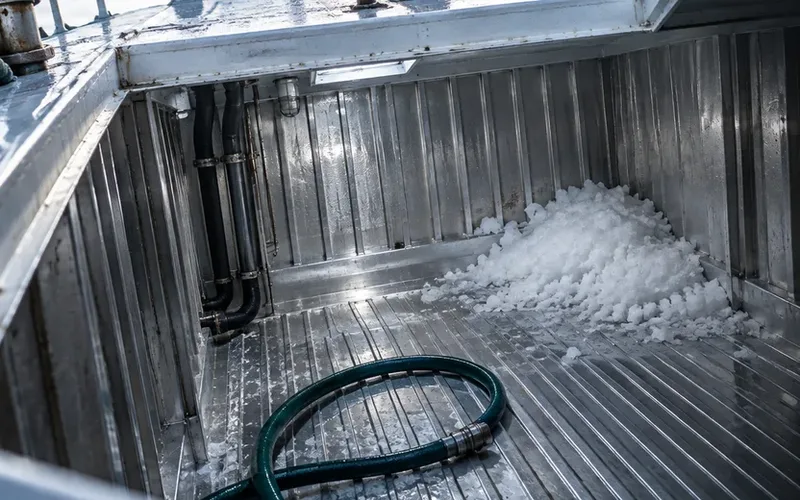
Sanitary Exchangers
Custom
Any shape the sheet can be cut to, any alloy that can be welded, and a drawing before a price.
+ Learn More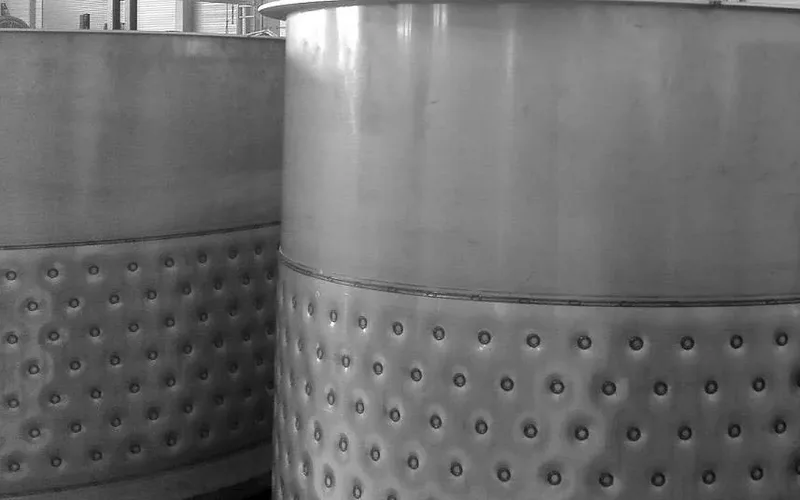
Sanitary Exchangers
Embossed Plate
Two stainless sheets welded and inflated into a heat transfer surface that goes wherever the tank needs it.
+ Learn More