
1-805-484-2992
Quotes - Engineering - SalesThe standard behind a validatable exchanger
ASME BPE, the Bioprocessing Equipment standard, is the document pharmaceutical and biotech engineers write into a specification when the exchanger will touch water for injection, purified water, buffers, media or product. Where 3-A asks whether a surface can be cleaned, BPE asks for proof: a measured finish grade on every product-contact surface, a log of every weld with its parameters and inspection result, material traceability to the heat, and geometry that drains without help.
The practical result is a heat exchanger that arrives with a turnover package the validation team can file, and that looks different on the inside from a food unit: brighter, with weld beads you can barely find, and with every connection sloped toward a drain. It costs more, mostly in labor and documentation, and on a WFI loop or a point-of-use cooler it is the correct spend.
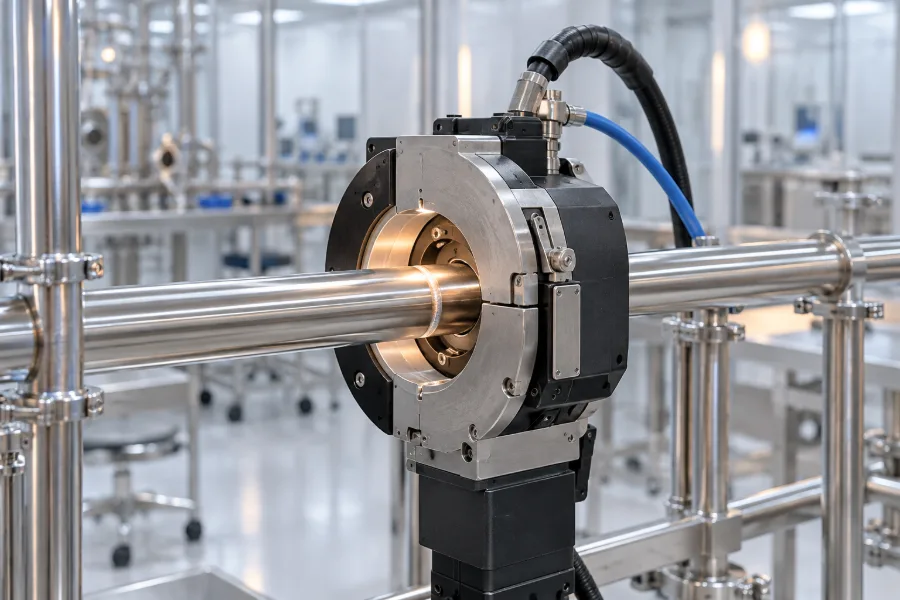
SF1 Mechanical
- 20 Ra maximum from mechanical polish
- Smeared metal and micro-folds remain
- Purified water, buffers and CIP supply
SF4 Electropolished
- 15 Ra maximum after electropolish
- Peaks removed, free iron lowered
- WFI, final product, hot stagnant-prone service
ASME BPE values used on heat exchangers
Surface finish (product contact)
- SF1: 20 Ra max (0.51 um), mechanically polished
- SF2: 25 Ra max (0.64 um), mechanically polished
- SF3: 30 Ra max (0.76 um), mechanically polished
- SF4: 15 Ra max (0.38 um), electropolished
- SF5: 20 Ra max (0.51 um), electropolished
- SF6: 25 Ra max (0.64 um), electropolished
Geometry and process
- Slope: Minimum 1/8 inch per foot on drained lines; unit fully drainable
- Dead legs: Branch length to diameter less than 2:1 (L/D under 2)
- Fittings: Hygienic clamp per BPE dimensions and gasket standard
- Welding: Orbital GTAW on tube and fittings, inspected and logged
- Materials: 316L with controlled sulfur for weldability, traceable by heat
- Passivation: Nitric or citric per BPE, with test and certificate
Every surface measured, every weld on record
What BPE changes on a heat exchanger
Choosing an SF grade
BPE defines six surface finish designations. SF1, SF2 and SF3 are mechanically polished at 20, 25 and 30 Ra maximum; SF4, SF5 and SF6 are the same three ceilings after electropolish, with SF4 the tightest at 15 Ra. Most WFI and purified-water exchangers are ordered at SF1 or SF4. The choice between them is less about the Ra number than about what electropolish does to the surface: it removes the smeared metal and micro-folds that a mechanical polish leaves, lowers the free iron at the surface, and leaves a chromium-rich layer that resists rouging in hot WFI.
On a shell-and-tube exchanger the SF grade applies to the tube bores, the tubesheet product face and the channel heads. Tube bores on small-diameter sanitary tube are electropolished as tube, before the bundle is built.
- SF1 (20 Ra mechanical): purified water, buffers, CIP supply
- SF4 (15 Ra electropolished): WFI, final product, anything hot and stagnant-prone
- Ra is measured with a stylus profilometer at a stated cutoff; the report states the instrument and locations
Welding, inspection and the weld log
BPE product-contact welds on tube and fittings are made by orbital gas tungsten arc welding with an inert purge on the inside. The purge keeps the root bright; a weld with heat tint on the product side is rejected because the oxide is chromium-depleted and will rouge. Each weld gets a number on the weld map, and the log records the machine, the program, the operator, the material heats on both sides, and the inspection result. A sample of welds is borescoped and the video is included in the package.
Tube-to-tubesheet joints are the exception to orbital work. They are seal welded, then the product face is ground and polished to the same SF grade as the rest of the head.
Slope, dead legs and drainability
BPE is explicit where 3-A is general. Drained lines slope at least 1/8 inch per foot toward the drain. Branch connections that see no flow are held to a length-to-diameter ratio under 2, which on a heat exchanger means instrument tees, sample points and vent connections are cut short and placed where they flow. The unit itself must drain completely from its lowest product connection with no assistance.
On a horizontal shell-and-tube unit this puts the product on the tube side with the tubesheets vertical, the low nozzle at the bottom of the head, and the head interior shaped without a ledge. On a U-tube bundle it rules out horizontal mounting on the product side unless the bundle is rotated so the U-bends drain.
Passivation and the turnover package
After fabrication and polish, the product side is passivated with nitric or citric acid per the BPE procedure to remove free iron and restore the chromium-oxide film, and the result is tested (a copper sulfate or ferroxyl check is common) and certified. The turnover package then collects everything: material test reports by heat, the weld map and log, the surface finish report, the passivation certificate, hydrotest report, drawings as built, and the nameplate data. A validation engineer should be able to trace any product-contact surface to its mill certificate and its finish reading without asking the fabricator.
When you do not need all of it
BPE was written for bioprocess product and the water that makes it. A steam-to-plant-water exchanger in the same building, or a glycol cooler on a CIP return, does not need SF4 and a hundred-page package. Specify BPE where the fluid is WFI, purified water, media, buffer or product, and specify a food-grade or 3-A unit elsewhere. Call and talk it through with an engineer: 1-805-484-2992
Common FAQs
No. It is a design and fabrication standard. There is no BPE stamp on the unit. Conformance is shown by the drawings, the finish report, the weld log and the material certificates in the turnover package.
BPE requires that the product be protected from the utility; a double tubesheet is the accepted way to do that on a shell-and-tube exchanger and most WFI specifications call for it. Some point-of-use duties with potable utility water accept a single tubesheet with the product on the tube side.
Yes. Sanitary plate units with electropolished plates, BPE-dimension clamp ports and compliant gaskets are used on purified-water and buffer duty. The frame and plate pack are documented the same way.
Both meet a tight Ra number, but SF4 is electropolished. In hot WFI the electropolished surface resists rouging noticeably longer and derouges more easily. On ambient purified water the difference is small.
Related
Design & Fabrication
3-A Sanitary
Built and verified to 3-A 12-07 or 11-09, with the symbol on the nameplate and the paperwork behind it.
+ Learn More
Design & Fabrication
Food-Grade Drainable
The design practice for beverage, brewing, sauces and non-inspected food duty: cleanable and dry.
+ Learn More
Design & Fabrication
Sanitary Standards
3-A, ASME BPE and food-grade drainable: what each one requires, what it costs, and how to pick the right one.
+ Learn More