
1-805-484-2992
Quotes - Engineering - SalesThe product side is a different design problem
On an industrial exchanger both sides are designed for heat transfer and pressure drop and nothing else. On a sanitary exchanger one side carries the product, and that side has to satisfy a second set of rules: it must be smooth enough that soil releases under CIP, shaped so that nothing stays behind when the pump stops, sealed so the utility can never reach it, and able to take the chemical and thermal punishment of a cleaning cycle several hundred times a year without changing.
Those four requirements map to four design details. Surface finish and electropolish set how fast the surface cleans and how long it resists corrosion. The tubesheet arrangement sets how the product is protected from the utility. Connections and orientation set whether the unit drains. And the CIP and SIP program the unit will face sets the gasket material, the tube wall, and how the design handles thermal cycling.
Each detail has a page below with the numbers. This page explains how they interact, because a decision on one changes the others.
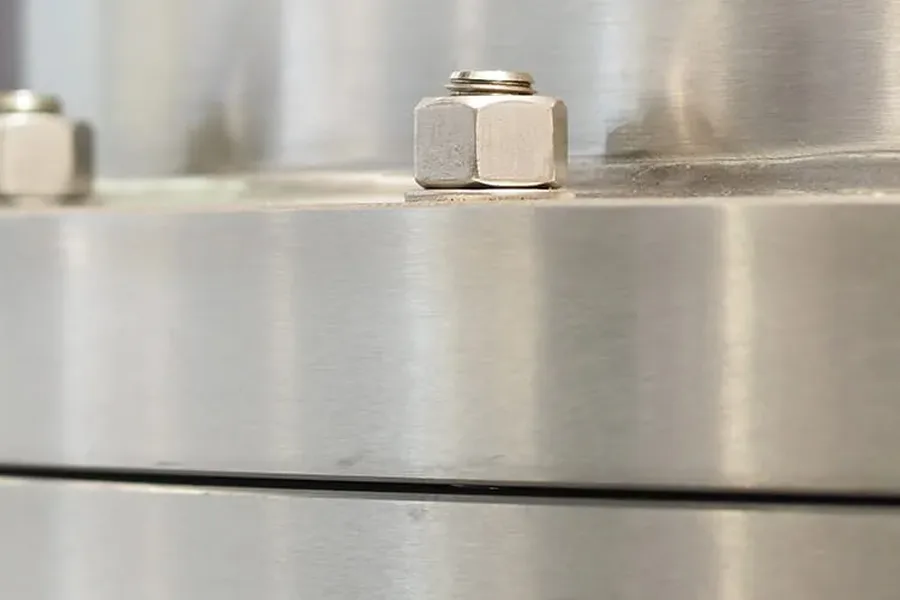
Surface Finish
- 32 Ra product side is the food default; 15 to 20 Ra for pharma
- Mechanical polish to 180, 240 or 320 grit, then electropolish where specified
- Electropolish removes 0.0002 to 0.0005 inch and passivates in one step
- Utility side commonly left at 63 Ra or mill finish to save cost
Double Tubesheet
- Two tubesheets with an air gap between them at each end
- A failed joint leaks to atmosphere, not into the other fluid
- Standard on WFI and most pharma; optional on food with potable utility
- Adds length, tube count and price; removable-bundle versions exist
Connections & Drainability
- Tri-clamp 1.5 to 4 inch is the North American default
- I-line, bevel seat, DIN 11851 and SMS where the plant already uses them
- Low-point drain and high-point vent on the product side, always
- Orientation and slope shown on the drawing, not left to the installer
CIP & SIP
- Caustic at 160 to 180 F, then acid, at 5 ft/s through the product channel
- SIP at 250 F for 30 minutes cycles the whole unit hot and cold
- Gasket compound chosen for the chemistry, not just the temperature
- Plate units open for inspection; shell-and-tube units rely on velocity



How the four details interact
A double tubesheet on a straight-tube unit means four tubesheet faces to polish instead of two, which is where the finish cost climbs on a pharma order. Electropolish makes the CIP faster but does nothing for a horizontal unit that holds product in the head; the drain comes first. Putting product on the tube side to keep it out of the baffled shell makes a single tubesheet acceptable on food duty, but it also fixes the tube velocity, which has to be high enough for CIP even if the process flow is low.
The right order of decisions is: which side is product, how the unit drains, what tubesheet arrangement the duty needs, and only then the finish grade.
The design most food plants should buy
Product on the tube side, single tubesheet with seal-welded and polished tube joints, 32 Ra product side, 63 Ra utility side, tri-clamp product connections, a low-point drain and a high-point vent, mounted on a slope, EPDM gaskets. That unit cleans in place, drains dry, passes a customer audit and is priced sensibly. Everything past it is for a specific reason: 316L for chlorides, a double tubesheet for a non-potable utility or a pharmaceutical product, electropolish for hot WFI or a QA group that wants it.
Where the utility side matters
The utility side is usually treated as industrial, and that is correct as long as the utility is steam, plant hot water, chilled water or glycol. Two cases change it. If the utility is a second product stream, as in a regenerative section of a pasteurizer, both sides are product-contact and both get the sanitary treatment. If the unit will be stored idle and cold, the utility side should drain too, or the water left in it will corrode the tubes from the outside in over a winter.
Getting the drawing right
The general arrangement should show which nozzle is product in and out, the slope, the drain and vent, the gasket material at every joint, the finish on each surface, and the tubesheet arrangement in section. A drawing with those items on it can be approved by QA without a meeting. Call and talk it through with an engineer: 1-805-484-2992
Common FAQs
On a shell-and-tube unit, the tube side, almost always. The tube bores are straight, polishable and drainable; the shell side has baffles and pockets. The exceptions are viscous products in a tube-in-tube unit, where the product may take the annulus, and some evaporators.
Electropolish leaves a passive, chromium-rich surface and is accepted as a passivation step by most specifications. A separate chemical passivation is still run on units that were mechanically polished only, and after any repair welding.
No. It changes the shell length, the tube length and the head design. Decide at the order. If the duty may move to pharmaceutical water later, the premium now is cheaper than a second unit.
About 5 feet per second is the common target for turbulent cleaning in sanitary tube. If the process flow gives less, the CIP skid pumps harder, and the unit's pressure drop at CIP flow is what sizes that pump.
Related
Design & Fabrication
Sanitary Standards
3-A, ASME BPE and food-grade drainable: what each one requires, what it costs, and how to pick the right one.
+ Learn More
Design & Fabrication
Materials
The metal in the tubes, the rubber in the joints, and the paper that proves which heat went where.
+ Learn More
Design & Fabrication
Codes & Certification
Pressure codes, registration numbers and sanitary marks: what each is, who requires it, and where it goes.
+ Learn More