
1-805-484-2992
Quotes - Engineering - SalesWhat an HTST pasteurizer actually is
High-temperature short-time pasteurization heats fluid milk to at least 161 F (72 C), holds it there for at least 15 seconds, and cools it to 40 F or below in a single continuous pass. The heat exchanger is not one exchanger but three or four in one frame: a regeneration section where cold raw milk meets hot pasteurized milk through the plate, a heating section fed by hot water, a holding tube that fixes the residence time, and a cooling section on chilled water or glycol. A flow diversion valve at the end of the holding tube sends any sub-temperature milk back to the balance tank.
Regeneration carries most of the load. Raw milk at 40 F is lifted to roughly 145 to 155 F by the outgoing product, so the hot water section only has to add the last 10 to 20 degrees and the cooler only has to remove what regeneration left behind. Regeneration efficiency of 85 to 95 percent is normal on a gasketed plate unit; each point of efficiency is heat you do not buy twice.
Request a Quote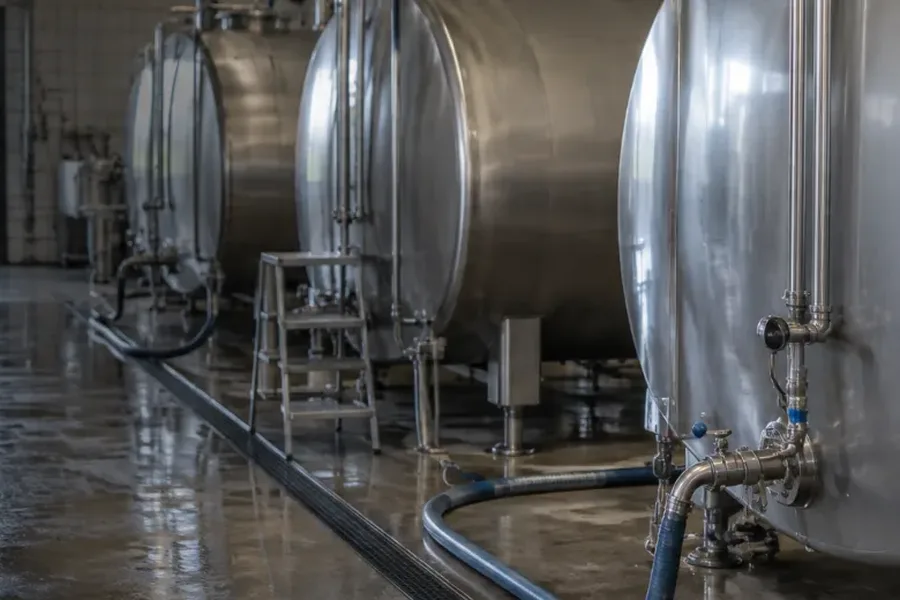
Regeneration lifts raw milk most of the way to 161°F
Raw milk at 40°F picks up heat from the outgoing pasteurized stream until it is within 10 to 20 degrees of setpoint, at 85 to 95 percent efficiency. A 15 second hold at 5 ft/s needs roughly 90 feet of sloped tube, timed on the fastest particle.
Plate pasteurizer, the standard answer
- Three sections in one frame with intermediate connection plates
- Regeneration 85 to 95 percent, hot water lift of 10 to 20 degrees
- Pasteurized side held 1 psi above raw side through the regenerator
- 3-A 12-07 plates, EPDM gaskets, 316L product plates
- Opens for inspection; plates and gaskets replaceable one at a time
Tubular pasteurizer, when plates are wrong
- Pulp, fiber or fat above 30 percent that would block plate channels
- Long runs between CIP on fouling products
- Higher pressure on either side than a gasketed frame will hold
- Straight-tube or tube-in-tube regenerator, U-tube on the steam-fed hot water set
- No gaskets in the product path other than tri-clamp seals
Recommended construction by HTST duty
The product decides the section type; the utility and the pressure decide the rest. These are the pairings HeatX quotes most often.
| DUTY / CONDITION | RECOMMENDED CONSTRUCTION | WHY |
| Fluid milk, skim to whole, 5,000 to 60,000 lb/h | Gasketed Plate | Highest regeneration per square foot, opens for inspection, cheapest heat transfer area in the plant |
| Cream, ice cream mix, 30 to 40 percent fat | Wide-Gap Plate | Twice the channel gap keeps velocity and pressure drop sane at cream viscosity; plates still regenerate well |
| Milk with pulp, cocoa or fiber; flavored milk | Corrugated Tube | Tube-in-tube passes solids, corrugation keeps the coefficient up on the product side |
| Hot water set for the heating section on plant steam | U-Tube | Steam on the tube side, free expansion, no bellows; keeps live steam off the product exchanger |
| Chilled water or glycol final cooler on a tubular line | Straight Tube | Fully drainable, brushable, no U-bends to trap product; sanitary tri-clamp both ends |
| Regeneration section where a plate leak cannot be tolerated | Double-Wall Plate | Two plates with a vented air gap between raw and pasteurized milk; any leak shows at the vent, not in the product |
How the four sections are sized
Start with the holding tube, because it is the one component the inspector times with a stopwatch. Its length is set by the fastest particle, not the average velocity: for turbulent flow the fastest particle travels about 1.2 times the mean velocity, so a 15 second legal hold at a mean velocity of 5 ft/s needs a tube on the order of 90 feet, sloped upward at least 1/4 inch per foot with no restrictions, and the indicating thermometer and recorder sensor at its outlet. Change the flow rate and the hold time changes with it, which is why the timing pump is a positive displacement pump or a magnetic flow meter loop with a sealed setpoint.
The regeneration section is sized on the approach you are willing to pay for. At 90 percent regeneration the raw milk leaves the regenerator about 12 degrees below the pasteurized temperature and the pasteurized milk leaves it about 12 degrees above the raw inlet. Pushing to 95 percent halves that approach and roughly doubles the plate count in the section; the payback is usually two to four years on a line that runs two shifts. The pasteurized side must run at least 1 psi higher than the raw side through the whole section so a pinhole leaks the safe direction, which is why a booster pump sits downstream of the regenerator on the pasteurized side.
The cooling section removes what regeneration leaves. With 90 percent regeneration the product arrives at the cooler around 52 F and must leave at or below 40 F; on 34 F chilled water that is a routine duty, on tower water it is impossible, and on propylene glycol at 28 F it takes about half the plates. If the product then goes to a filler at 36 F the cooler is sized on glycol and the chilled water section drops out.
Sizing the sections so the holding tube is honest
Pressure differential and the booster pump
The PMO requires that pasteurized product in the regenerator be at higher pressure than raw product, and that the relationship hold during the whole run, during CIP, and when the flow diversion valve is in divert. In practice that means a booster pump on the pasteurized side interlocked to the timing pump, a differential pressure switch across the regenerator, and a design where the raw side drains before the pasteurized side when the system shuts down.
Flow diversion and the recorder
The flow diversion valve is a three-way sanitary valve at the outlet of the holding tube, driven by the safety thermal limit recorder. It has to move to divert in under one second, it has to be leak-detect type so that product cannot pass to forward flow during a divert, and the exchanger pressure drop calculation has to include the divert leg so that the timing pump cannot over-speed the holding tube when the forward leg closes.
Running time between cleanings
A fluid milk pasteurizer with a 5 degree hot water approach and 1 psi of gasket margin should run 8 to 12 hours before the pressure drop across the heating section rises 20 percent. Cream lines run shorter, high-solids mixes shorter still. If the plant needs a 20 hour run, the fix is more area in the heating section at a lower wall temperature, not a bigger pump.
What HeatX needs to quote it
Product and fat content, flow rate in lb/h or gpm, raw inlet temperature, pasteurization setpoint and hold, final outlet temperature, hot water and chilled utility available, and whether the unit is plate, tubular or your choice. With those in hand a pasteurizer is a one-conversation quote. Call and talk it through with an engineer: 1-805-484-2992
Common FAQs
It is the legal minimum for fluid milk. Products with 10 percent or more fat, or added sweetener, go to 166 F for 15 seconds; with both, 175 F. Egg nog and frozen dessert mix have their own tables. HeatX sizes the holding tube and sections for the highest setpoint the line will run.
Yes. A sanitary straight-tube or tube-in-tube regenerator with a U-tube hot water set and a tubular cooler is a legal HTST arrangement and is the right one for pulp, fiber or high fat. It regenerates less per square foot than plates, so the frame is longer and the payback on regeneration is slower.
85 percent is easy, 90 percent is the usual design point, 95 percent is available at roughly double the regeneration plates. Above that the approach gets so close that fouling swings the outlet temperature more than the design margin.
Setpoint plus 3 to 5 degrees. A 20 degree approach heats the milk faster but bakes protein onto the plates and halves the run time between CIP cycles.
Related
Applications
UHT & ESL
Indirect sterilizers for 275 to 285 F and ESL heaters for 250 to 260 F, built to run a shift between CIPs.
+ Learn More
Applications
Milk, Cream & Whey
Raw milk to 38 F in one pass, cream heated without channeling, whey cooled without scaling.
+ Learn More
Applications
Yogurt & Cheese
Mix heaters, culture-temperature coolers, cheese-milk warmers and whey heaters that respect cultured product.
+ Learn More