
1-805-484-2992
Quotes - Engineering - SalesMore surface without giving up the open bore
A multi-tube module bundles a small number of product tubes, commonly three to nineteen at 3/4" to 1-1/2" OD, inside a single jacket. Product is distributed among the tubes at a sanitary header and recombined at the other end; the utility flows in the jacket around all of them. Compared with a single tube of the same jacket size, the bundle carries several times the heat transfer surface per foot and splits the flow so each tube runs at a velocity that keeps it clean, which shortens the bank for a given duty.
The bore of each tube still sets the largest particle, so multi-tube modules are chosen for pulp, seeds, fibers and small particulates up to roughly 1/2", and for viscous liquids without pieces that need more area than a single tube can economically provide: fruit juice with heavy pulp, concentrates, tomato paste at moderate consistency, smoothies, yogurt, dressings, syrups and dairy desserts.
Headers are the sanitary detail that matters. Product must divide evenly among the tubes or one tube runs slow, fouls and shortens the run. The header is designed as a smooth, drainable chamber rather than a manifold of branches, and it is tri-clamped so it can be opened.
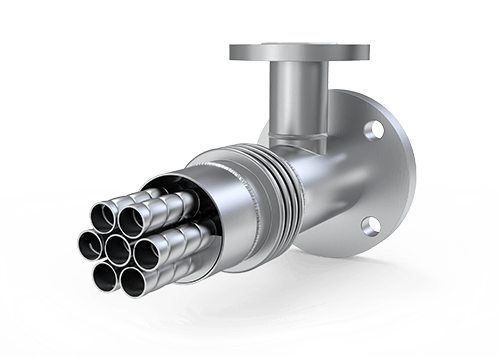
Seven tubes in one jacket do the work of a single tube bank three times as long, and each of the seven runs fast enough to stay clean.
Multi-tube for pulp, fibers, small particulates and viscous liquids at production flow.
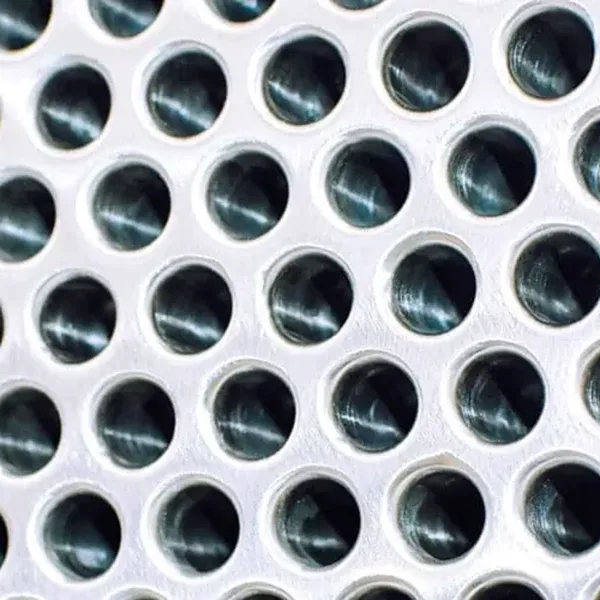
Surface without losing the bore
- Several times the surface per foot of a single tube
- Flow split keeps each tube above settling velocity
- Shorter bank for the same duty
- Corrugated tube option for laminar viscous product
- Pulp, seeds and fibers pass without bridging
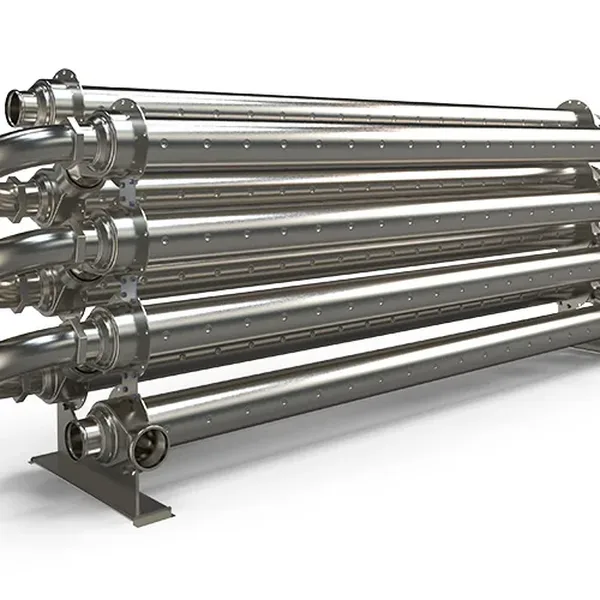
Headers that distribute evenly
- Smooth drainable chamber instead of a branch manifold
- Every tube sees the same entry condition
- Tri-clamped header opens to show the tubesheet face
- Straight bores accept a brush from the header end
- Whole bank drains to a single low point
Standard Features




Multi-tube, typical sanitary build
The rows give the usual build for a multi-tube module, including the largest particle it passes and the jacket arrangement. Compare them with your product and send particle size, flow and temperatures with the request.
| Feature | Detail |
| Tube count and OD | 3 to 19 tubes at 3/4", 1" or 1-1/2" OD, smooth or corrugated |
| Largest particle | Up to roughly 1/2" soft particulate in 1-1/2" tubes; pulp and fibers in any size |
| Product finish | 32 Ra standard; 20 Ra or electropolished on request |
| Headers | Sanitary distribution chambers, tri-clamped, drainable, seal welded to the tubes |
| Jacket | 4" to 8" typical, utility velocity 3 to 6 ft/s |
| Module length | 10 to 20 ft; banks connected with sanitary return headers |
| Design pressure | 150 psig standard; higher on request |
| Design temperature | 350 F and higher; steam on the jacket routine |
| Materials | 304L or 316L tubes and headers; 304L jacket standard |
| Codes | ASME U-stamp on the jacket as required, 3-A conformance, PED, CRN |
Where multi-tube modules fit and how they are laid out
Juice with pulp and concentrates
Citrus and tropical juices with heavy pulp, and juice concentrates at 40 to 65 Brix, are the classic multi-tube duty. Pulp passes through a 1" tube without bridging, the split flow keeps each tube above the velocity that lets pulp settle, and the concentrated product at the cold end of an evaporator or a cooler runs at a viscosity that plates would struggle with. Pasteurizers for pulpy juice are built as multi-tube banks with a holding tube of the same construction and a cooling bank after it, often with a small regeneration section where the product is clean enough.
Viscous liquids without pieces
Yogurt, dressings, syrups, dairy desserts, plant-based creams and similar products are viscous enough to defeat plates and clean enough not to need a large single bore. Splitting the flow among smaller tubes raises the surface-to-volume ratio and, because each tube is shorter for the same duty, lowers the residence time of heat-sensitive product. For these products the tube count is set so pressure drop lands within the pump's range at the coldest viscosity, and corrugated tubes are substituted when the laminar coefficient needs help.
- Higher surface per foot than single tube
- Shorter residence time for heat-sensitive product
- Tube count tuned to pump pressure at cold-end viscosity
- Corrugated tube option for laminar product
Even distribution and the header design
The header is where a multi-tube module succeeds or fails. A tapered or domed chamber with the tubes seal welded to a polished tubesheet gives each tube the same entry condition; a plain pipe tee does not, and the far tubes starve. With uneven distribution one tube runs at half velocity, fouls first and raises the pressure drop for the whole bank. Headers are also the drain points: the module is pitched so the outlet header is low and carries a drain, and the header is tri-clamped to the jacket so it can be removed for inspection of the tubesheet face and tube ends. Tube counts, bundle sizes and header options are detailed on our multi-tube exchanger pages.
Cleaning, expansion and bank arrangement
CIP runs through all tubes in parallel at a velocity checked at sizing, and the straight bores accept a brush from the open header end. Because the tubes and jacket see different temperatures, each module has one end free to move, with the tube bundle fixed at one header and floating at the other through a sanitary gland or an expansion element on the jacket. Modules are stacked on a frame with return headers between them, utility piped in counterflow, and the whole bank arranged so it drains to a single low point.
Multi-tube is the tube-in-tube construction for products that need real surface at production flow without losing the open bore. Call and talk it through with an engineer: 1-805-484-2992
Common FAQs
Single tube when the largest piece is over about 1/2", when fibers are long enough to wrap, or when the flow is small. Multi-tube when the product is pulp, small particulates or viscous liquid and the flow is large enough that a single tube bank would be impractically long.
By the header design. A smooth, tapered or domed distribution chamber gives every tube the same entry condition. The sizing also keeps the number of tubes modest so the flow split stays even at the actual viscosity.
The headers are tri-clamped and remove to expose the tubesheet face and every tube end, so each straight bore can be brushed, pigged or borescoped from the open end.
From water-like up to several thousand centipoise with smooth tubes, and higher with corrugated tubes. The practical limit is pump pressure at the coldest point in the process, which the sizing reports with the design.
Yes with clean, pulpy or moderately viscous product by running cold product in the jacket of a regeneration bank. The jacket side is less cleanable than the tubes, so this is limited to products that CIP proves out; heavy particulate lines skip it.
Either. Steam gives the most heat per module and is common for cooking. Hot water is used where product would scorch at steam temperature or where a closer wall temperature control is wanted.
Related
Sanitary Exchangers
Single Tube
The largest open bore in sanitary heat transfer: one product tube, one jacket, nothing in the way.
+ Learn More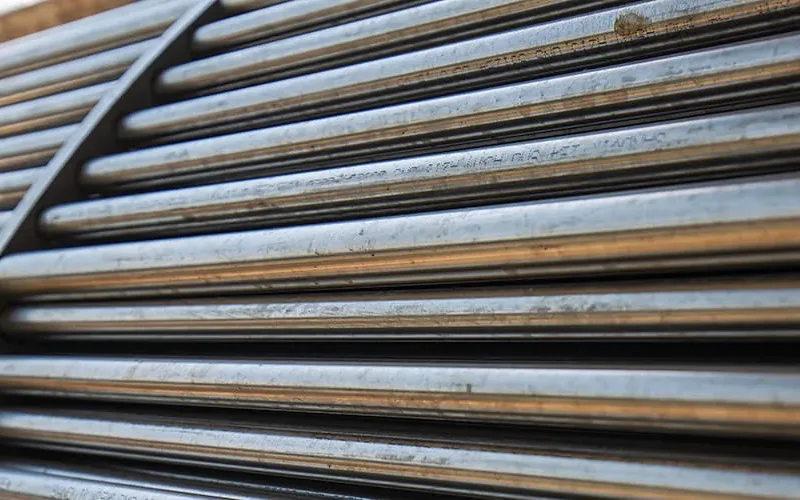
Sanitary Exchangers
Corrugated Tube
A spiral pressed into the product tube turns laminar product turbulent without narrowing the bore.
+ Learn More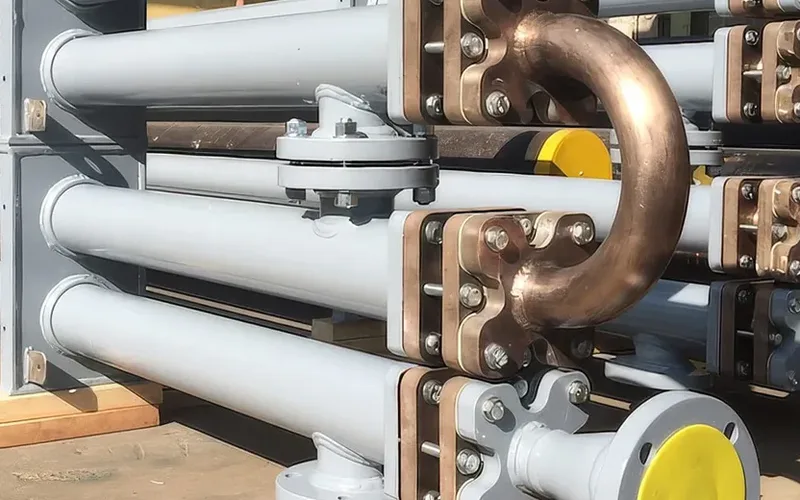
Sanitary Exchangers
Tube-in-Tube
One straight product tube inside a jacket: nothing to plug, nothing to bridge, and full counterflow.
+ Learn More