
1-805-484-2992
Quotes - Engineering - SalesFinish is a number, and the number is measured
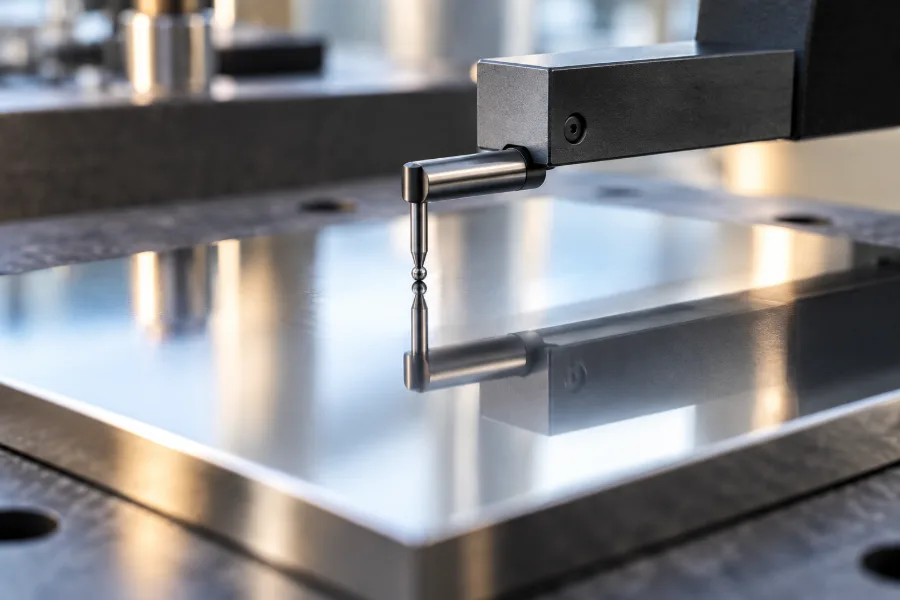
Surface finish on a sanitary heat exchanger is stated as Ra, the arithmetic average roughness in microinches (or micrometers), and it is read with a stylus profilometer dragged across the surface. It is not a grit number, a mirror, or a description. A specification that says polished or sanitary finish has not specified anything. A specification that says 32 Ra maximum on product-contact surfaces, profilometer verified, has.
The reason it matters is soil release. A rougher surface has deeper valleys that hold protein and fat below the reach of the CIP flow, so cleaning takes longer or fails. Below about 32 Ra the improvement in cleanability flattens for food soils, which is why 3-A and most food specifications stop there. Pharmaceutical water and product go tighter, to 20 or 15 Ra, because the concern shifts from soil to biofilm and rouge on a surface that sees hot water continuously.
Mechanical Polish
- 180 grit lands near 32 Ra
- Leaves smeared metal and folded-over peaks
- Fine for food soils and CIP
Electropolish
- Cuts Ra by roughly a third
- Strips 0.0002 to 0.0005 inch from the peaks
- Resists rouging in hot pharmaceutical water
Finish levels and what produces them
Mechanical polish
- 180 grit: About 32 Ra; the 3-A and food-grade default
- 240 grit: About 20 to 25 Ra; BPE SF1 or SF2 range
- 320 grit: About 15 to 20 Ra; usually followed by electropolish
- 2B mill finish: About 40 to 60 Ra; utility side and shell exterior
- Bright annealed tube: Typically under 32 Ra as drawn; check the cert
Electropolish and measurement
- Metal removed: 0.0002 to 0.0005 inch, preferentially from peaks
- Effect on Ra: Reduces by roughly a third from the mechanical starting point
- Surface chemistry: Free iron removed, chromium-to-iron ratio raised
- Instrument: Stylus profilometer, stated cutoff, several traces averaged
- Report: Location, instrument, cutoff and each reading, per surface
32 Ra where product flows, 63 Ra where it does not
Producing and proving a sanitary finish
Mechanical polishing
A sanitary finish starts with abrasive. Tube is bought already polished or bright annealed to the required Ra; heads, tubesheets, ferrules and fabricated parts are polished in the shop with progressively finer belts and wheels. The grit sequence 180, 240, 320 corresponds roughly to 32, 25 and 18 Ra on stainless, though the relationship depends on the abrasive, the pressure and the operator, which is exactly why the grit number is not the specification and the Ra reading is.
Mechanical polishing leaves a directional pattern of fine scratches and a thin layer of smeared, work-hardened metal with folded-over peaks. For food duty at 32 Ra that surface is fine. For pharmaceutical duty it is the reason electropolish exists.
- Polish direction should run with the flow where possible; cross-hatch is acceptable if Ra is met
- Welds on the product side are ground flush before polishing so the bead does not stand proud
- Inside corners and ferrule bores are the hardest to polish and the first to fail a reading
What electropolish does
Electropolishing is reverse electroplating. The part is the anode in an acid electrolyte, and current strips metal from the surface, fastest from the peaks where current density is highest. Removing 0.0002 to 0.0005 inch takes off the smeared layer, rounds the peaks, and cuts Ra by about a third from the mechanical starting point; a 20 Ra mechanical surface comes out at roughly 12 to 15. Just as important, it removes free iron and manganese sulfide inclusions at the surface and leaves it enriched in chromium, which is why an electropolished surface resists rouging in hot water and takes longer to show pitting in chloride service.
Electropolish does not fix a bad mechanical finish. Deep scratches get brighter, not smaller. The mechanical polish underneath has to already be close to the target.
Measuring Ra
Ra is measured by drawing a diamond stylus across the surface over a sampling length and averaging the absolute deviation from the mean line. The cutoff length, usually 0.030 inch for sanitary work, filters out waviness so the reading reflects roughness alone. A single reading proves little; the report should give several traces per surface, taken at marked locations, with the instrument identified. On tube, readings are taken along the bore of sample lengths from each heat. On tubesheets, readings are taken on the ligaments between tube holes, where the polish is hardest to reach.
A visual comparator or a sample coupon is a useful shop aid and is not a measurement. If the order calls for Ra, the deliverable is a profilometer report.
Where each level belongs
On food duty the product side is 32 Ra and the utility side is 63 Ra or mill finish, because the utility side never sees product and polishing it would add cost without a cleaning benefit. On dairy under 3-A the same 32 Ra applies. On purified water and buffers a 20 Ra mechanical finish (BPE SF1) is usual. On WFI, on injectable product, and on any hot stagnant-prone surface, 15 Ra electropolished (SF4) is the common specification. Going tighter than the duty needs adds polishing hours and inspection time and returns nothing the CIP will notice.
Writing the finish into the order
State the maximum Ra for product-contact surfaces, the maximum for utility surfaces if you care, whether electropolish is required, and that a profilometer report is a deliverable. That is enough for the shop to price and for QA to accept. Call and talk it through with an engineer: 1-805-484-2992
Common FAQs
Below the level the soil requires, no. It costs more and cleans no faster. 32 Ra is the practical floor for food soils; 15 to 20 Ra is justified where biofilm and rouge in hot water are the concern.
It can, and on a regenerative section where both streams are product it must. Otherwise leave it at mill finish or a light bead blast to keep the price down.
Slightly. Removing up to 0.0005 inch per surface is within tolerance for tubes and heads but matters on gasket seats and ferrule faces, which are electropolished before final machining or masked.
In clean service it lasts the life of the unit. Aggressive chloride CIP, abrasive product or mechanical damage will roughen it, and a re-reading after a few years tells you whether it still meets spec.
Related
Design & Fabrication
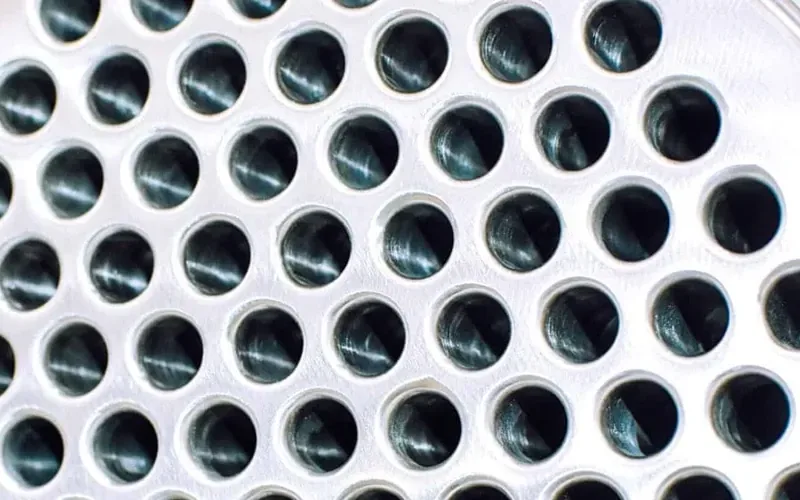
Double Tubesheet
Two tubesheets, an air gap, and a leak that shows up on the floor instead of in the product.
+ Learn More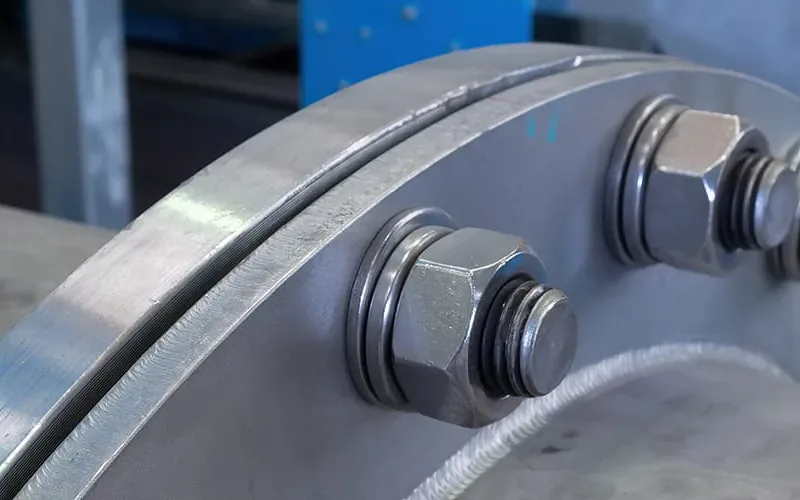
Design & Fabrication
Connections & Drainability
Which fitting standard to use, what size, where the drain and vent go, and how the unit has to sit to empty.
+ Learn More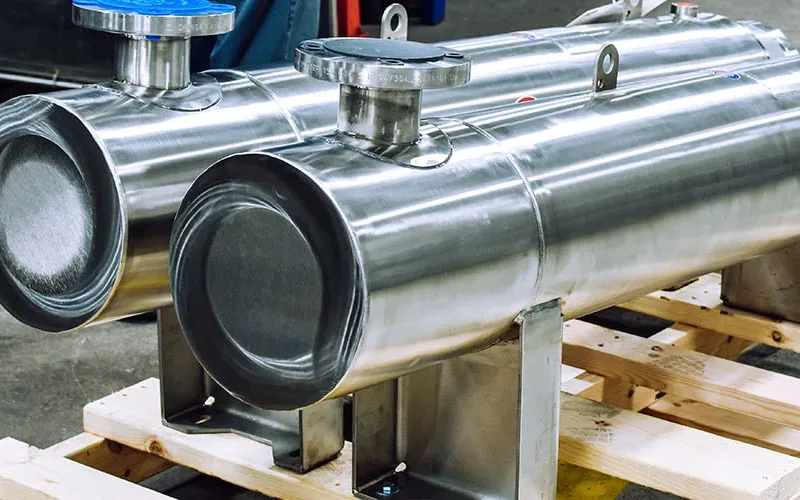
Design & Fabrication
CIP & SIP
What a cleaning and sterilizing cycle does to the metal, gaskets and joints, and how the unit is built for it.
+ Learn More