
1-805-484-2992
Quotes - Engineering - SalesTurbulence where a smooth tube gives you none
Viscous product in a smooth tube runs laminar. The layer at the wall moves slowly, heats or cools first and insulates the core, so the coefficient is low and the wall runs far from the bulk temperature. A corrugated tube has a shallow spiral or ring pattern pressed into its wall. The pattern disturbs the boundary layer continuously along the length, trips the flow into turbulence at a much lower velocity than a smooth tube, and mixes the wall layer back into the core. Coefficients rise by a factor of two or more for the same velocity, banks get correspondingly shorter, and the wall runs closer to the bulk, which is what protects heat-sensitive product.
The bore is unchanged. A corrugated 1-1/2" tube passes the same pulp and particulates as a smooth one; the corrugation depth is small compared with the diameter, and the pattern is rounded so it does not trap solids. Corrugated tubes are supplied in both single-tube and multi-tube modules, on the product tube only or on both product tube and jacket.
The other benefit is fouling. Because the wall layer is constantly swept, deposits of protein, sugar or starch build more slowly, and the same turbulence makes CIP more effective at the same flow. Production runs between cleanings are longer and the cleaning cycle is shorter.
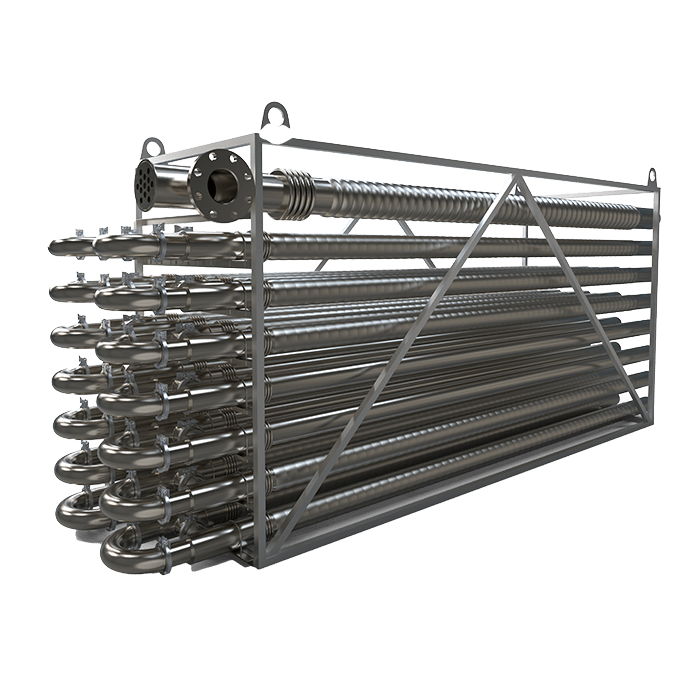
The same product, the same tube diameter, the same pump, and a bank half the length: that is what a corrugated wall buys.
Turbulence at low velocity for viscous product, with slower fouling and faster CIP.
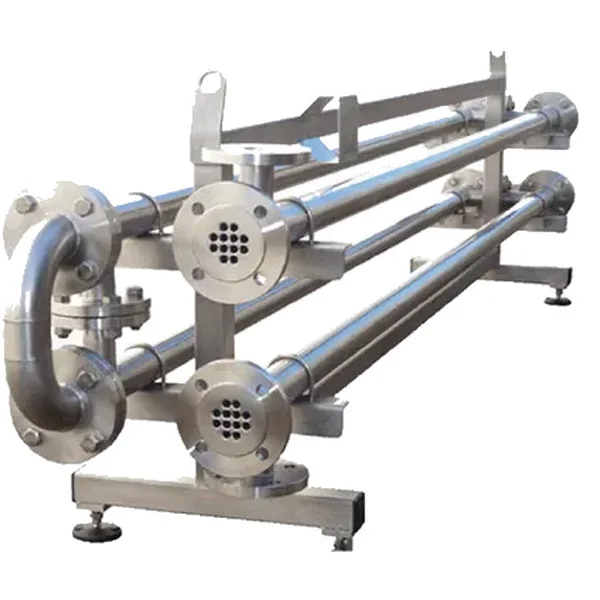
Turbulence at low velocity
- Coefficient at least doubles against smooth tube in laminar flow
- Banks roughly half as long at equal pressure drop
- Wall runs closer to bulk product temperature
- Gentler wall temperatures protect flavor, color and texture
- Same bore passes the same pulp as a smooth tube
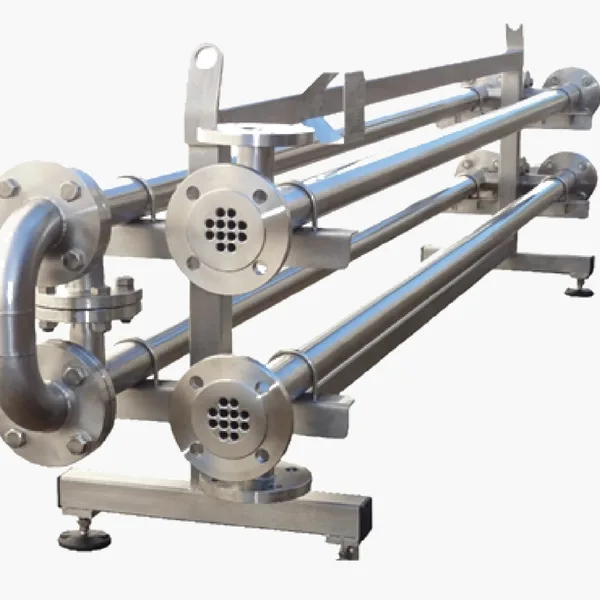
Longer runs, shorter cleans
- Wall layer swept so deposits build slowly
- Pressure drop drifts slowly through a production run
- Better caustic and acid contact at the wall
- Rounded shallow pattern leaves no crevices
- Polished after forming, finish verified along the pattern
Spec Highlights


Corrugated tube, typical sanitary build
The standard corrugated tube build is listed here so you can compare it with your viscosity and particle size. Include your product, flow and temperatures in the quote request and sizing follows from them.
| Feature | Detail |
| Corrugation | Spiral or annular, shallow and rounded; depth small relative to tube diameter |
| Tube OD | 3/4" to 4", single or multi-tube modules |
| Coefficient gain | Generally 2x or better against a smooth tube at the same velocity in laminar product |
| Bore and particle | Same as the smooth tube of the same OD; corrugation does not trap solids |
| Product finish | 32 Ra on the corrugated surface; electropolished on request |
| Jacket | Smooth or corrugated; corrugated jacket raises utility-side coefficient |
| Design pressure | 150 psig standard; higher on request |
| Design temperature | 350 F and higher; steam on the jacket routine |
| Materials | 304L or 316L product tube; 304L jacket standard |
| Codes | ASME U-stamp on the jacket as required, 3-A conformance, PED, CRN |
Applying corrugated tubes to sanitary product
Viscous liquids: purees, sauces, dairy desserts
Products in the range of a few hundred to several thousand centipoise are where the corrugation pays for itself. Fruit purees, tomato products, cheese sauces, puddings, custards, yogurt, cream cheese and plant-based creams all run laminar in a smooth tube and need long banks. With corrugated tubes the same duty fits a bank roughly half the length at the same pressure drop, or the same length at a lower velocity and pressure. The sizing compares smooth and corrugated on the actual rheology and reports both. Viscous duties outside food and dairy are covered on our viscous thermal processing pages.
Heat-sensitive product and wall temperature
In laminar flow the wall layer can sit 30 to 50 F above the bulk on a steam-heated tube, which is where proteins denature, sugars caramelize and starches gel onto the wall. Mixing the wall layer back into the core narrows that difference and lets the process reach its hold temperature with less damage to flavor, color and texture. That is the reason corrugated tubes are specified on egg products, dairy desserts, baby food and nutritional beverages even when a smooth bank would technically meet the duty.
- Wall-to-bulk difference reduced by continuous mixing
- Less caramelization and protein burn-on
- Hot water on the jacket where steam would still scorch
- Shorter residence time in the heated zone
Fouling and cleaning behavior
Fouling is a film that grows at the wall where velocity is lowest. A corrugated wall never lets that layer settle, so films build more slowly and the pressure drop and outlet temperature drift more slowly through a run. When CIP does come, the same turbulence gives the caustic and acid cycles better contact at the wall at the same flow, and plants generally report shorter cleaning cycles. The corrugation is rounded and shallow, so it does not create crevices; the tube is polished after forming and the finish is verified along the pattern.
When smooth tube is still the better choice
Corrugated tubes are not brushed or pigged as readily as smooth bores because the pig cannot seal against the pattern, so products that require mechanical cleaning stay on smooth tubes. Large particulates and long fibers that could catch, even on a rounded pattern, also stay smooth. And a water-like product that is already turbulent in a smooth tube gains little from corrugation and is better served by the plain tube or by plates. The choice is made on the product's viscosity at process temperature, its solids and its cleaning method.
Corrugated tubes are the quiet upgrade that turns a long, slow, fouling bank into a short, clean one. Call and talk it through with an engineer: 1-805-484-2992
Common FAQs
For laminar product, commonly about half the length at the same pressure drop, because the coefficient roughly doubles. The exact ratio depends on viscosity and velocity, and the sizing shows both options side by side.
No. The pattern is shallow and rounded, polished after forming, and the bore is the same as the smooth tube. Pulp and small particulates pass as they would in a smooth tube. Large pieces and long fibers are still sent to smooth single-tube modules.
At the same velocity, somewhat. But because the bank is shorter for the same duty, total pressure drop through the bank is usually equal to or lower than the smooth-tube alternative.
Generally not; a pig cannot seal against the pattern. CIP is the cleaning method, and the turbulence makes it more effective. Products that require pigging use smooth tubes.
Yes. Corrugated tubes are used in multi-tube bundles for viscous liquids and pulpy juice, and the jacket can also be corrugated where the utility-side coefficient is the limit.
Purees, tomato products, sauces, puddings, custards, yogurt, cream cheese, egg products, nutritional beverages, plant-based creams and any viscous product that is heat sensitive or fouls a smooth tube. Send a viscosity at process temperature and the sizing will show whether corrugation is worth it.
Related
Sanitary Exchangers
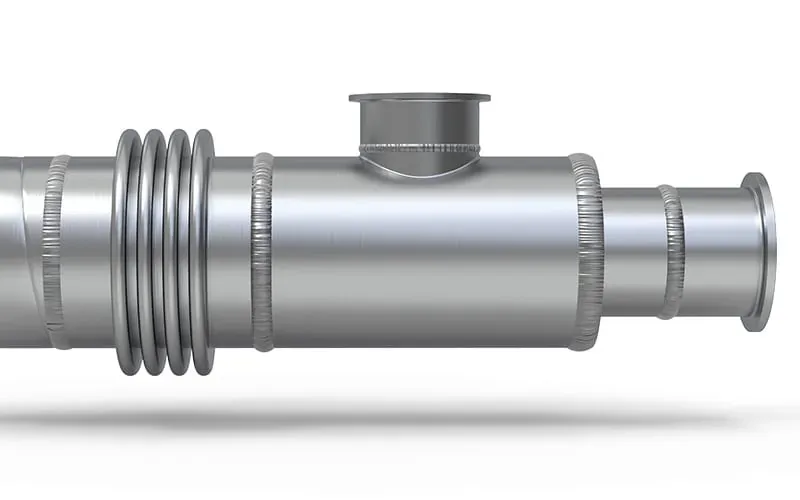
Single Tube
The largest open bore in sanitary heat transfer: one product tube, one jacket, nothing in the way.
+ Learn More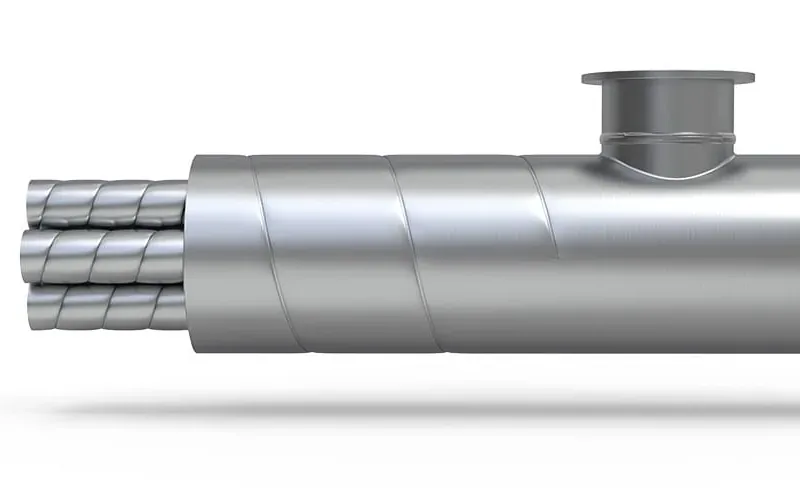
Sanitary Exchangers
Multi-Tube
Several product tubes in one jacket: tube-in-tube handling with several times the surface per foot.
+ Learn More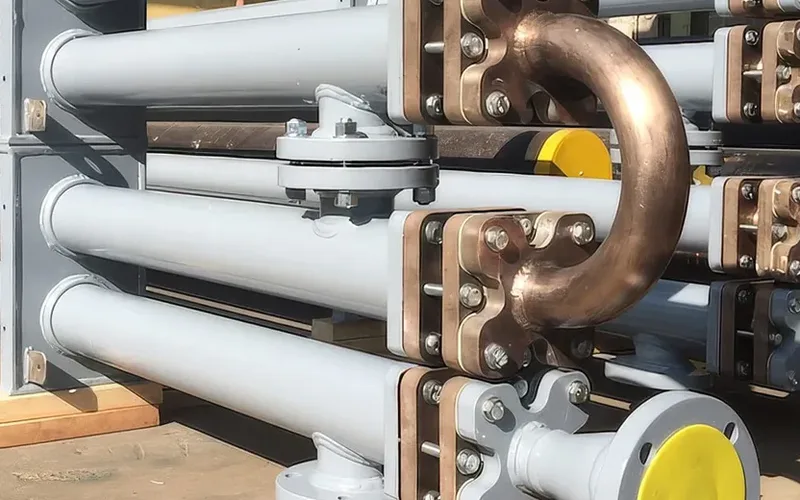
Sanitary Exchangers
Tube-in-Tube
One straight product tube inside a jacket: nothing to plug, nothing to bridge, and full counterflow.
+ Learn More