
1-805-484-2992
Quotes - Engineering - SalesThree standards, three levels of proof
When a purchase order says sanitary and nothing more, the fabricator has to guess. The guess is usually a polished 304L unit with tri-clamp ends and no third-party verification, which is fine for a juice line and not fine for a dairy under a state inspector or a WFI loop under an FDA audit. The three standards on this page exist to remove that guess. Each one defines materials, finishes, fittings and drainability, and each one asks for a different kind of evidence that the rules were followed.
3-A Sanitary Standards come from 3-A Sanitary Standards, Inc. and are what dairy and food inspectors in the United States look for. ASME BPE is the bioprocessing equipment standard used for pharmaceutical and biotech duty, with tighter finish grades and full documentation of welds and materials. Food-grade drainable is not a published standard at all; it is a design practice that borrows the useful parts of both without the registration or the paperwork.
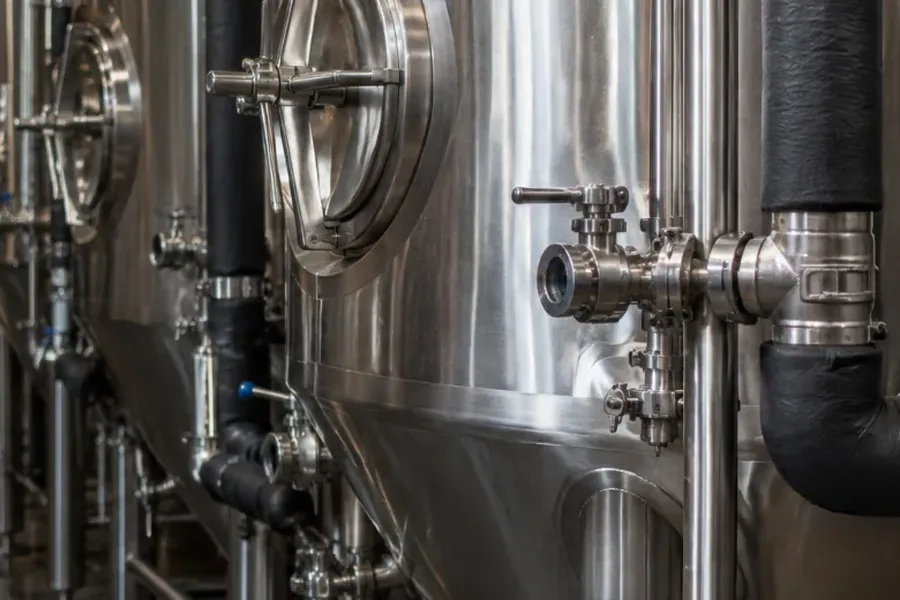
3-A Sanitary
- Standard 12-07 covers tubular heat exchangers, 11-09 covers plate types
- Product-contact finish 32 Ra or better, 300-series stainless or approved alloys
- Fabricator holds a 3-A Symbol authorization after a Third Party Verification
- Expected by dairy, egg and many food inspectors in the United States
ASME BPE
- Surface finish designations SF1 through SF6 with defined Ra limits
- Hygienic clamp fittings, orbital welds with weld logs and borescope records
- Slope, dead-leg and drainability rules written into the design
- The default for WFI, purified water, buffers and bioreactor utilities
Food-Grade Drainable
- Self-draining geometry, crevice-free product side, cleanable in place
- Elastomers compliant with FDA 21 CFR 177, stainless wetted parts
- No registration, no symbol, no third-party audit of the shop
- Right for beverage, sauces, brewing and most non-inspected food duty
What they share
- No pockets, no threads, no exposed crevices on the product side
- Gaskets and O-rings that can be removed and replaced without damaging the seat
- Product side able to be cleaned and, where required, sterilized in place
- Materials documented by heat number back to the mill




How to choose
Start with who will inspect the plant. A Grade A dairy under the Pasteurized Milk Ordinance will have a state or FDA inspector who expects the 3-A symbol on the exchanger, and a unit without it invites a citation regardless of how well it was built. A biopharmaceutical facility runs on validation packages, and the QA group will ask for ASME BPE finish reports, weld logs and material certificates before the unit is allowed near the loop. A brewery, a juice plant or a sauce kitchen usually answers to its own HACCP plan and an occasional third-party audit, and a well-detailed food-grade drainable unit satisfies both.
What each one adds to the price
Moving from food-grade drainable to 3-A adds the finish verification, the authorized shop, and typically a modest premium on a shell-and-tube unit and less on a plate unit, because plate frames were designed around the standard from the start. Moving to ASME BPE roughly doubles the documentation effort: every product-contact weld is logged, every wetted heat of material is traceable, finish is reported by profilometer, and the unit ships with a turnover package that can run to a hundred pages.
Common misreadings
3-A is not a certification of the exchanger in the way a U-stamp is. It is an authorization held by the fabricator to apply the symbol to equipment built in conformance with a specific standard, backed by a third-party inspection of the shop and its designs. ASME BPE is likewise a design and fabrication standard, not a stamp. Neither replaces the ASME pressure-vessel code; a sanitary unit needs the code stamp for pressure and the sanitary standard for cleanability, and they are separate line items.
EHEDG is a European guideline, useful as a reference on drainability and cleanability testing, but it is not what a North American inspector is looking for and it does not substitute for 3-A on a dairy floor.
Write it into the order
Name the standard, the edition if your QA group tracks it, and the specific finish grade. For 3-A, state that the unit is to carry the symbol. For BPE, state the SF grade for product-contact surfaces and whether electropolish is required. For food-grade drainable, list the drain points and the elastomer compliance you need. Call and talk it through with an engineer: 1-805-484-2992
Common FAQs
Yes, and it is common on pharmaceutical duty that also falls under a food-type inspection, such as nutritional products. The unit is built to the tighter BPE finish and documentation rules and then registered under 3-A so it can carry the symbol. Expect BPE pricing.
3-A standards reference FDA material rules for elastomers and plastics, so a 3-A unit uses compliant gaskets. FDA compliance of the process, though, is about the plant's operation and validation, not the exchanger by itself.
Under 3-A, yes: plate units fall under 11-09 and tubular units under 12-07. The intent is the same, but plate units have specific rules for gasket retention and plate inspection. ASME BPE covers both constructions in one document.
Specify the same sanitary standard your QA group validates against, and add PED for the pressure side. EHEDG certification of the exchanger is available on some plate designs and can be discussed if a customer or auditor asks for it.
Related

Design & Fabrication
Product-Contact Design
The four details that decide whether the product side cleans, drains and stays uncontaminated.
+ Learn More
Design & Fabrication
Materials
The metal in the tubes, the rubber in the joints, and the paper that proves which heat went where.
+ Learn More
Design & Fabrication
Codes & Certification
Pressure codes, registration numbers and sanitary marks: what each is, who requires it, and where it goes.
+ Learn More