
1-805-484-2992
Quotes - Engineering - SalesExtraction, concentration and ready-to-drink
The product is made hot and has to be made cold fast
Coffee and tea are extracted with hot water, and the extract that comes off the column at 180 to 200 F loses aroma with every minute it stays there. The first exchanger on the line is therefore a cooler, and it has to be a fast one, taking the extract to 40 F or below in a single pass so that volatiles stay in the liquid and the flavor does not go flat and cooked.
Around that cooler sit the extraction water heater, a pasteurizer for ready-to-drink product and, on concentrate lines, an evaporator with aroma recovery. Cold brew extracts at ambient and is then chilled.
Four duties on a coffee or tea line
Extraction water and the extract cooler
Extraction water is heated to 195 to 210 F, often under a little pressure to reach the higher end, in a steam-to-water shell-and-tube or a plate exchanger on 15 to 30 psig steam. It is a clean water duty in 304L; the flow varies with the extractor's cycle, so the heater is controlled on outlet temperature with a modulating steam valve.
The extract cooler is the important one. Extract at 180 to 200 F and 10 to 25 percent solids goes through a plate cooler on tower water and then glycol to 36 to 40 F. Coffee extract carries fines and oil, and above about 15 percent solids it is better in a corrugated tube-in-tube where the fines pass and the wall can be brushed. Tea extract is thinner and cleaner and stays on plates.
Ready-to-drink tea and coffee
Bottled iced tea at pH 3 to 4 with citric acid is a high-acid beverage and pasteurizes at 195 to 205 F for 15 to 30 seconds on a three-section plate pasteurizer with regeneration, then hot fills or cools for cold fill. Black coffee sits at pH 4.8 to 5.5 and is on the wrong side of 4.6; with milk or sugar it is unambiguously low-acid and has to be UHT-treated or retorted, which is a different exchanger and a different page.
Tea pasteurizers foul with tannin, a hard brown film that caustic alone does not lift. The CIP is caustic for the organics, then an acid step at 140 F, then a sanitizer, and the plate pack is opened every few months for inspection of the gasket lands where the film is thickest.
Cold brew and concentrates
Cold brew is steeped at 60 to 75 F for 12 to 24 hours, filtered, and chilled to 36 to 40 F on a plate cooler on glycol before kegging or bottling. There is no thermal kill step, so the exchanger, the filter and the filler are the whole microbial defense and the CIP is run every batch.
Instant coffee and tea concentrate go through a falling-film or forced-circulation sanitary evaporator at 100 to 130 F under vacuum, taking the extract from 15 to 50 percent solids. Aroma stripped in the first effect is condensed on a chilled vapor condenser and added back to the concentrate.
The common mistake
Sizing the extract cooler for the average extraction rate. Column extractors deliver in pulses at two or three times the average flow; a cooler sized on the average lets that pulse through at 80 F and the aroma goes with it. Size on the peak. Send the extractor cycle, the peak and average flows, the solids and the outlet temperature. Call and talk it through with an engineer: 1-805-484-2992




Coffee and tea extract process conditions
Extract duty ranges from a clear cold-brew stream to a fines-laden concentrate, and the rows below cover that spread. Compare them with your extract strength and send your cleaning routine with the quote request.
| Condition | Detail |
| Product | Coffee extract 5 to 25 percent solids; tea extract 3 to 15 percent; RTD beverages; cold brew |
| Flow range | Extract 5 to 100 gpm; RTD pasteurizer 30 to 300 gpm; extraction water 20 to 300 gpm |
| Temperatures in / out | Extract 180 to 200 F to 36 to 40 F; RTD 40 F to 195 to 205 F and back; water 55 F to 195 to 210 F |
| Hold | RTD tea: 195 to 205 F for 15 to 30 seconds; milk coffee is UHT or retort |
| Utility | Hot water or 15 to 30 psig steam on extraction water; tower water then glycol on extract coolers |
| Approach | 5 degrees on the RTD heater; 8 to 10 degrees on glycol; extraction water heater 15 degrees |
| Construction | Gasketed plate on clear extract and RTD; corrugated tube-in-tube on extract with fines |
| Finish / class | 316L product side, 32 Ra; 304L on extraction water; 3-A or food-grade drainable |
| CIP | Caustic at 160 F, acid at 140 F for tannin, sanitizer; every 8 to 24 hours |
Common FAQs
At pH 4.8 to 5.5 it is a low-acid beverage in a sealed container and needs UHT or retort, not a 195 F pasteurizer. Only acidified tea and coffee drinks below pH 4.6 run on a high-acid pasteurizer.
Tannins polymerize into a hard film above about 170 F and caustic does not lift it. An acid step at 140 F after the caustic does; skipping it costs 10 to 20 percent of heater capacity within a month.
Plates up to about 15 percent solids on clean extract; corrugated tube-in-tube above that or when fines and oil carry over from the extractor. Tea extract stays on plates.
To 40 F within a minute or two of leaving the column. Aroma loss is a function of time at temperature, so the cooler is sized on the extractor's peak delivery rate rather than its average.
Related
Applications
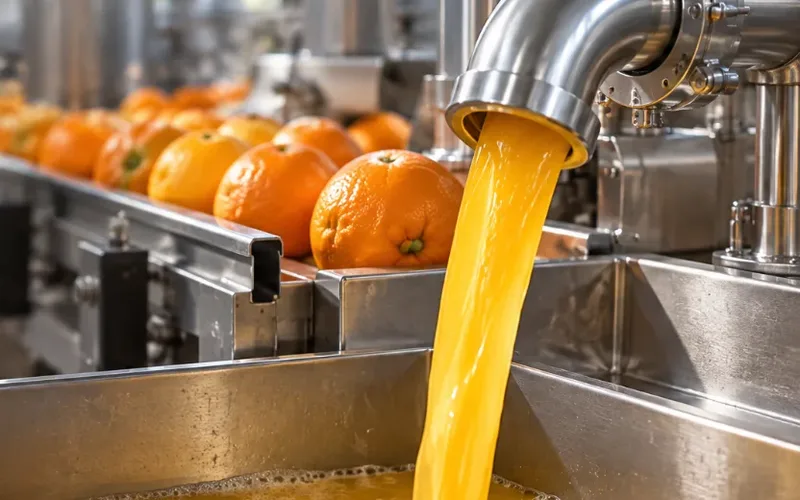
Juice Pasteurization
The 185 to 195 F pasteurizer for clear and pulpy juice, and the hot break that runs hotter still.
+ Learn More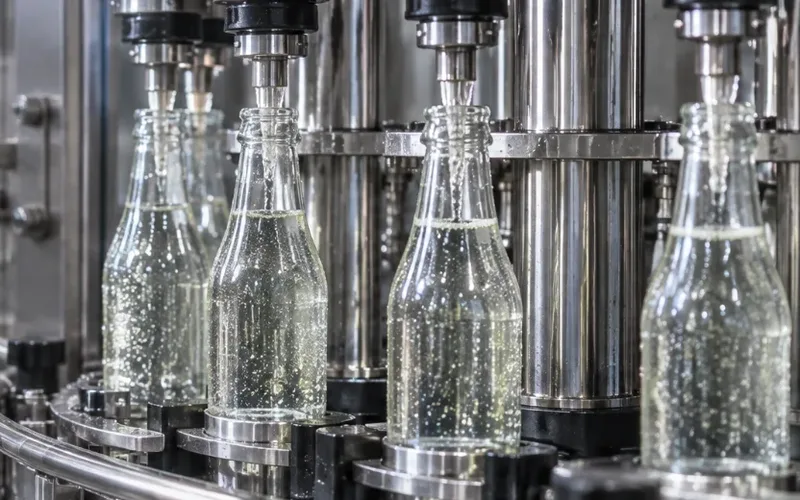
Applications
Hot Fill & Cooling
The cooler is either a small trim section for hot fill or the biggest exchanger on the line for cold fill.
+ Learn More
Applications
Soft Drinks & Water
Syrup at 65 Brix, product chilled to 36 F for CO2, water deaerated at 110 F, all on one plant floor.
+ Learn More