
1-805-484-2992
Quotes - Engineering - SalesAfter the hold
The fill method sizes the cooler
Everything after the holding tube depends on how the bottle is filled. A hot-fill line wants the product at 180 to 185 F at the filler so the container is pasteurized by the product itself; the cooler is a trim section that drops 5 to 15 degrees. A cold-fill or aseptic line wants 40 F or lower, and the cooler has to remove 150 degrees of heat that the hot-fill line never removes at all.
This page is about that cooling train: what regeneration recovers, what tower water and glycol each take, and how the cold end is kept moving.
Two cooling trains and the numbers behind each
Hot fill: a trim cooler and a steady 180 F
A hot-fill pasteurizer leaves the hold at 190 to 195 F and the filler wants 180 to 185 F, no lower, because the container, cap and headspace are pasteurized by the product during the 30 to 60 second inversion after capping. The trim cooler is small, one or two plates' worth on tower water, and the important thing about it is control. Overshoot to 170 F and the bottle is not sterilized; undershoot and the PET container shrinks. HeatX fits the trim section with a modulating tower water valve and a bypass so 180 F holds across the filler's speed changes.
The bottles then go through a cooling tunnel on sprayed water, which is where the product heat actually leaves the line. The tunnel's water is chilled in a separate plate exchanger on tower water then glycol, often bigger than the pasteurizer.
Cold fill: regeneration, tower water, glycol
A cold-fill or aseptic line has to take the product from 190 F to 40 F in the exchanger, and the cost of doing that is the whole argument for regeneration. With 90 percent regeneration on plates the raw product coming in at 45 F takes the pasteurized product down to about 60 F for nothing; tower water at 85 F cannot go lower than about 95 F on the product, so it is skipped on a well-regenerated line; glycol at 28 F finishes from 60 F to 40 F with an 8 to 10 degree approach.
On a tubular pulp line regeneration recovers 60 to 75 percent, the product leaves the regenerator at 85 to 100 F, and both tower water and glycol sections earn their place. A nectar at 40 F is two to three times as viscous as at 190 F, so the cold end carries the highest pressure drop and is sized on the outlet viscosity.
Glycol separation and double-wall plates
Propylene glycol is food-safe, but many plants' hazard analysis still refuses a single plate between a refrigerant loop and a finished product. The answer is a double-wall plate cooler, two plates laser-welded at the ports with a vented gap between them, so a failure in either wall leaks to atmosphere and shows at the sight glass rather than into the juice. It costs 10 to 15 percent in area at the same duty.
Where the plant runs ethylene glycol or ammonia-chilled water on the cold side, the double-wall plate or a tube-in-tube with a solid wall is not optional.
The common mistake
The line is built for hot fill with a trim cooler, and two years later marketing wants a cold-fill SKU in the same plant. The trim cooler cannot do it and the regenerator has no cold side. Building the frame with the ports and connection plate for a future glycol section costs almost nothing on day one. Send the fill method now and the one you might add. Call and talk it through with an engineer: 1-805-484-2992




Cooling section process conditions
The rows give the cooling duty after the hot fill or hold, with the utility and approach each stage runs on. Use them as a checklist against your line, and send your fill temperature and target with the quote request.
| Condition | Detail |
| Product | Pasteurized juice, nectar, tea, sports drink or flavored water leaving the hold at 185 to 195 F |
| Flow range | 20 to 600 gpm, matched to the filler's peak rate |
| Temperatures in / out | Hot fill: 190 F in, 180 to 185 F out. Cold fill: 190 F in, 36 to 40 F out |
| Hold | None; the hot-fill bottle inversion is 30 to 60 seconds at the filler |
| Utility | Regeneration, then tower water at 80 to 90 F, then propylene glycol at 26 to 30 F |
| Approach | 10 degrees regenerator terminal; 8 to 10 degrees on glycol to the product outlet |
| Construction | Gasketed plate on clear product; corrugated tube-in-tube on pulp; double-wall plate on glycol where required |
| Finish / class | 316L, 32 Ra product side; 3-A or food-grade drainable to the plant's specification |
| CIP | Cleaned with the pasteurizer as one circuit; acid on the tower water side twice a year |
Common FAQs
180 to 185 F, held within 2 degrees across speed changes. Below about 175 F the container and cap are not reliably pasteurized during the inversion hold.
On 200 gpm from 190 to 40 F, glycol alone is about 13 million Btu/h; after 90 percent regeneration the glycol section carries under 2 million.
Yes, and they usually do. The tunnel water chiller is the larger user; the trim cooler runs on tower water and only touches glycol on plants that trim below 175 F for a warm-fill process.
Whenever the plant's hazard analysis will not accept a single wall between the coolant and finished product, and always on ethylene glycol or ammonia-chilled loops. Propylene glycol on a single-wall plate is common where QA accepts it.
Related
Applications
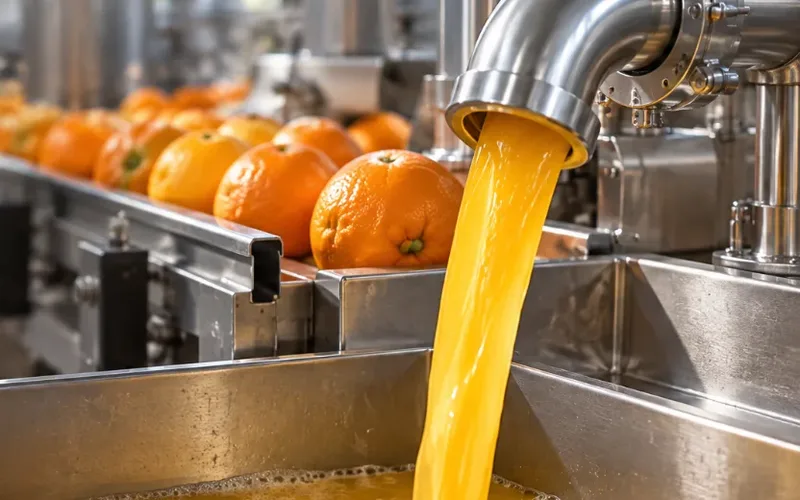
Juice Pasteurization
The 185 to 195 F pasteurizer for clear and pulpy juice, and the hot break that runs hotter still.
+ Learn More
Applications
Soft Drinks & Water
Syrup at 65 Brix, product chilled to 36 F for CO2, water deaerated at 110 F, all on one plant floor.
+ Learn More
Applications
Coffee & Tea Extracts
Hot water for extraction, fast cooling of the extract, and pasteurizers for ready-to-drink tea and coffee.
+ Learn More