
1-805-484-2992
Quotes - Engineering - SalesHot break, paste, sauce and ketchup
The product that browns first
Tomato is the sauce-line product with the least tolerance for a hot wall. Its sugars and amino acids brown on a surface much above 250 F, the brown layer insulates the tube, the outlet drops and the operator raises the steam, and by lunch the exchanger is scorched through. Everything on this page follows from keeping the wall within 30 degrees of the product.
The duties are the hot break at the crusher, warming paste for dilution, cooking and holding sauce or ketchup at 190 to 200 F, and cooling it for hot fill or chilled packaging. Sauces with dice to 1/2 inch run the same tubes.
Tomato from the crusher to the cooler
Hot break at the crusher
Freshly crushed tomato has active pectinase, and within minutes at 100 to 150 F it thins the juice and kills the body of the finished paste. A hot break heats the crushed mash to 200 to 210 F inside a minute of crushing, either by steam injection or in a tubular heater on hot water at 220 to 230 F, so the enzyme is dead before it acts.
The hot break exchanger is a multi-tube with 1-1/2 inch tubes or a large-bore single tube-in-tube, because the mash carries seeds and skins. It is the dirtiest exchanger in the plant: CIP twice a day in season, tubes pulled weekly.
Paste, sauce and ketchup cooking
Paste from the evaporator at 28 to 36 Brix is a semi-solid at room temperature, 3,000 to 5,000 cP, and is warmed to 120 to 140 F on hot water before it can be metered into a sauce blend. The blended sauce at 12 to 20 Brix, with oil, salt, sugar and diced vegetables, is then cooked to 190 to 200 F in a continuous tubular heater, held 30 seconds to 3 minutes depending on the size of the pieces, and sent to the filler or the cooler.
The heater is sized on a 20 to 30 degree approach with hot water at 220 to 230 F. That is the whole difference between a line that runs 12 hours and one that scorches in two. Tube length replaces the driving force a steam approach would give. Ketchup and other thick condiments run on the same hardware; see our thick sauces and condiments pages.
Cooling to hot fill or chilled
Hot-filled sauce in glass or pouches leaves the hold at 195 F and goes to the filler at 185 to 190 F, so the cooler is small or absent. Chilled sauce for retail or food service has to go to 40 F, and the cooler is the largest exchanger on the line: tower water takes the sauce to 100 F and glycol finishes it, with the sauce roughly four times as viscous at 40 F as it was at 195 F. The cold end is sized on that viscosity with a 10 to 15 degree glycol approach.
Regeneration on tomato sauce runs through a water loop, hot sauce heating water in one exchanger and that water preheating incoming sauce in another, and recovers 50 to 60 percent.
The common mistake
Feeding plant steam straight to the annulus of a tomato heater because the hot water set was cut from the budget. It works for an hour. The steam-to-water set is not optional on tomato; HeatX supplies it sized for the heater's peak load. Send the Brix, the viscosity hot and cold, the largest piece, the flow, the temperatures in and out and the hold. Call and talk it through with an engineer: 1-805-484-2992




Tomato sauce and paste process conditions
The rows run from the hot break to the cooled tote and show what each stage is sized for. Hold your own line against them and send the product range and utilities along with the quote request.
| Condition | Detail |
| Product | Crushed tomato 5 to 6 Brix; paste 28 to 36 Brix; sauce and ketchup 12 to 30 Brix; 200 to 5,000 cP |
| Flow range | Hot break 50 to 400 gpm; sauce lines 10 to 150 gpm |
| Temperatures in / out | Hot break 70 to 200 to 210 F; sauce 60 F to 190 to 200 F; cooled to 90 F hot fill or 40 F chilled |
| Hold | 30 seconds to 3 minutes at 190 to 200 F, set by the largest piece |
| Utility | Hot water at 220 to 230 F from a steam-to-water set; tower water then glycol on the cooler |
| Approach | 20 to 30 degrees on the heater; never plant steam on the product wall |
| Construction | Multi-tube or corrugated tube for smooth product; single tube-in-tube, 2 to 3 inch bore, for dice |
| Finish / class | 316L product side, 32 Ra; food-grade drainable; 3-A on lines that specify it |
| CIP | Caustic 1.5 percent at 170 F, acid for pectin and mineral film; 8 to 12 hour runs |
Common FAQs
Hot break heats crushed tomato to 200 to 210 F within a minute to kill pectinase and keep viscosity. Cold break heats to 150 to 160 F for fresher color and a thinner product used for juice.
Tomato has sugars, amino acids and low pH that brown on a wall above about 250 F, and the brown layer insulates the tube so the operator raises the heat. Hot water at a 20 to 30 degree approach keeps the wall below that threshold.
Two inches for dice to 1/2 inch, three inches where whole cherry tomatoes or 3/4 inch vegetable pieces are in the sauce. Pieces above that are dosed after the exchanger.
8 to 12 hours on sauce and ketchup with hot water heating; 6 to 8 hours on the hot break in season. Caustic then acid, with the acid step needed for the pectin and calcium film.
Related
Applications
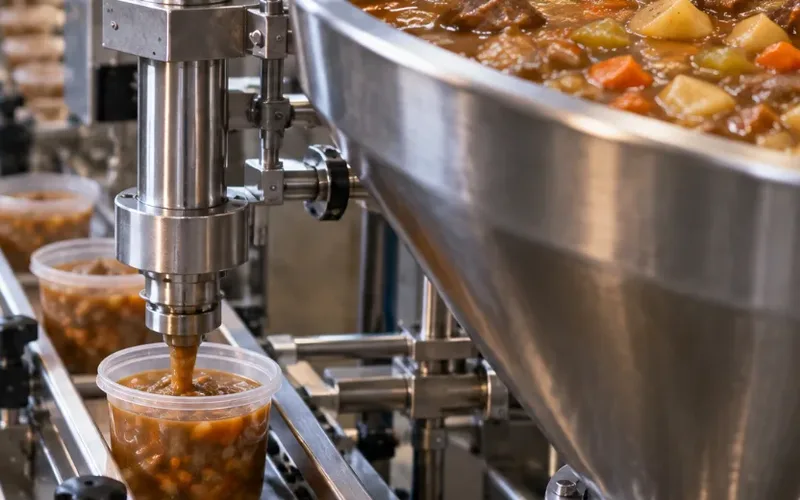
Soups & Stews
A thin broth carrying pieces to 1/2 inch, where the piece sets the bore and the hold.
+ Learn More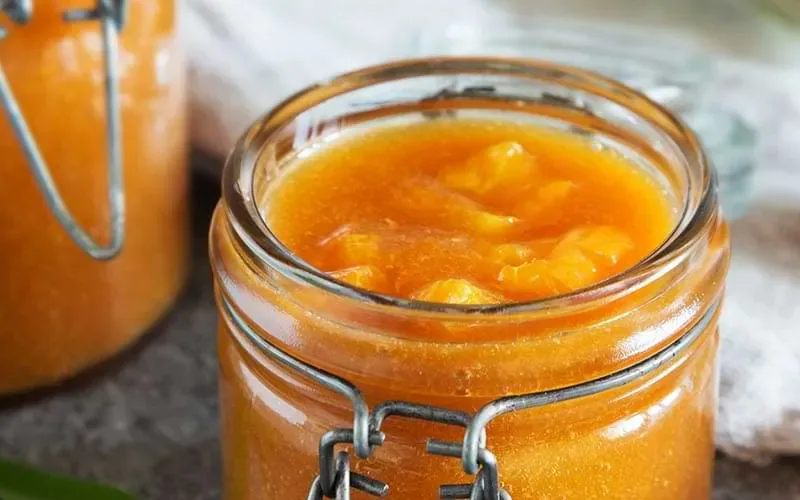
Applications
Fruit Preparations & Jams
High sugar, high viscosity, delicate fruit pieces and a wall that burns on if the approach is wrong.
+ Learn More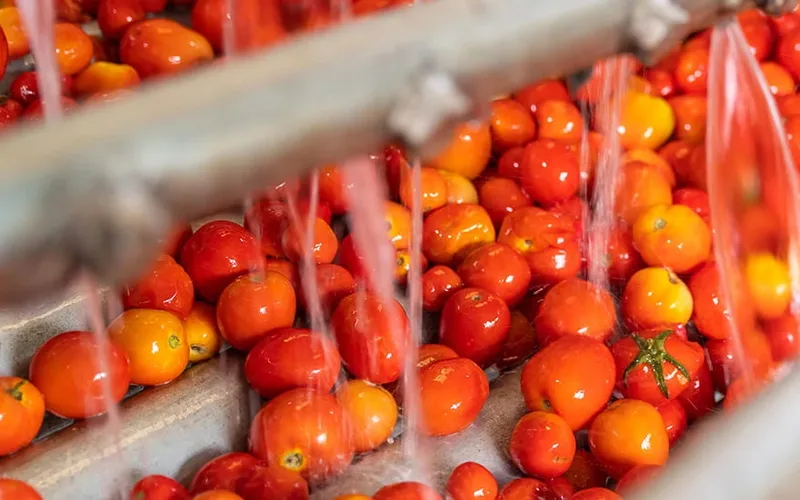
Applications
Purees & Baby Food
Smooth purees run the best coefficient on the sauce line; infant product runs the tightest process control.
+ Learn More