
1-805-484-2992
Quotes - Engineering - SalesProduct-contact or not
The symbol goes on the heater when the solution side is part of the product circuit
3-A Sanitary Standards define a product-contact surface as any surface the product touches, or from which liquid can drain, drip or be drawn into the product. A CIP heater never sees milk, but on a Grade A dairy the CIP supply is valved into the circuit the milk ran through, and a regulator working from the Pasteurized Milk Ordinance treats the solution side of that heater as product-contact. On that plant the heater carries the 3-A symbol; on a beverage plant whose skid is separated from product by a mix-proof valve and an air break, it usually does not.
The parent page covers the heater's sizing and chemistry. This page is about classification: which heaters need the symbol, what the standard adds to the construction, and how to tell an inspector which case you are in.
3-A on a CIP heater: what it covers and what it costs
When the heater is product-contact
The test is whether solution leaving the heater can reach product-contact surfaces without an air break. On a dairy HTST that is cleaned in place through its own product piping, the CIP supply enters the product circuit directly and the heater's solution side is classed with the pipe. The same is true of a UHT plant, an aseptic filler with an integrated CIP return, and a brewery bright tank line cleaned through the product manifold. On a plant where CIP solution reaches product equipment only through a valve matrix with a mix-proof seat and a leakage chamber, or through a break tank, many inspectors accept a sanitary heater without the symbol.
HeatX asks which case the plant is in and quotes both ways where it is unclear. The symbol adds cost and lead time; leaving it off a heater the inspector later classes as product-contact costs a replacement.
What the standard adds to the build
The 3-A standard for tubular heat exchangers governs the product-contact zone, on a CIP heater the solution side. Surfaces are 300 series stainless at 32 Ra or better, corners radiused, no threads or exposed fasteners in the zone, self-draining at the piping pitch, and every gasket in the zone a 3-A accepted material removable for inspection. Tube joints are welded and ground on the product side or the bundle is removable for examination. The steam side is outside the zone. What 3-A asks of the rest of the CIP equipment is set out on our 3-A CIP pages.
- Solution side 304 or 316L, 32 Ra, radiused corners, no threads, no dead pockets
- Removable heads or removable bundle so the zone can be inspected
- Symbol authorization by third-party verification, with the document kept on the skid
The heater as inspection evidence
The 3-A symbol is not law; the PMO is. The symbol settles the question in an inspection without a debate about construction, because the third-party verifier already had it. On a Grade A plant that is worth the price on any heater in the product circuit. Elsewhere a heater built to the same details without the authorization satisfies most inspectors, and the drawing carries the 32 Ra callouts and gasket materials to show it.
The common mistake
Paying for 3-A on the steam side. A supplier quotes the whole heater to the standard, polishes the shell that steam sees, and the price doubles for no benefit the inspector will ever look at. The zone is the solution side only; the steam side is a pressure vessel, and HeatX quotes it that way. The reverse mistake is a bare sanitary heater in a Grade A circuit, which is a red tag the first time a regulator asks for the symbol. Call and talk it through with an engineer: 1-805-484-2992




3-A CIP heater conditions
When the cleaning solution later flows through product piping, the heater has to meet the same hygienic standard. The rows below set out that build; send your circuit flow and steam supply with the quote request.
| Condition | Detail |
| Fluid | Caustic, acid and rinse solutions that will later flow through product piping |
| Flow range | 30 to 500 gpm at the circuit's CIP flow |
| Temperatures in / out | Solution 100 F to 170 F caustic, 150 F acid; steam 250 to 300 F on the utility side |
| Hold | Set by the cleaning validation, 20 to 40 minutes at return temperature |
| Utility | Plant steam at 15 to 50 psig; culinary steam where the plant's practice requires it near product |
| Approach | Not limiting; outlet controlled within 2 to 3 degrees |
| Construction | 3-A tubular heat exchanger: U-tube or straight tube, solution side built to the standard, steam side conventional |
| Finish / class | 3-A symbol authorized; solution side 304 or 316L, 32 Ra or better, radiused corners, no threads, self-draining |
| Ratings | 150 psig at 375 F steam side; solution side to pump shutoff |
| CIP / SIP | Solution side cleaned by its own cycle; inspectable through removable heads or bundle |
Common FAQs
Under the PMO on a Grade A dairy, a heater whose solution side is part of the product circuit is treated as product-contact equipment and the symbol is the accepted evidence. Elsewhere a sanitary heater built to the same details usually satisfies the inspector without it.
Third-party verification, documentation, welded and ground tube joints on the solution side, and removable heads. Typically 15 to 30 percent over a sanitary heater of the same size, on the solution side only.
No. The standard covers the product-contact zone, which on a CIP heater is the solution side. The steam side is an ordinary pressure vessel side, rated 150 psig at 375 F.
A 3-A tubular exchanger can heat product on one duty and CIP solution on another, but the utility side and the pressure relationship must suit both, and a heater that will see product should have its own page of requirements. Ask before combining them.
Related
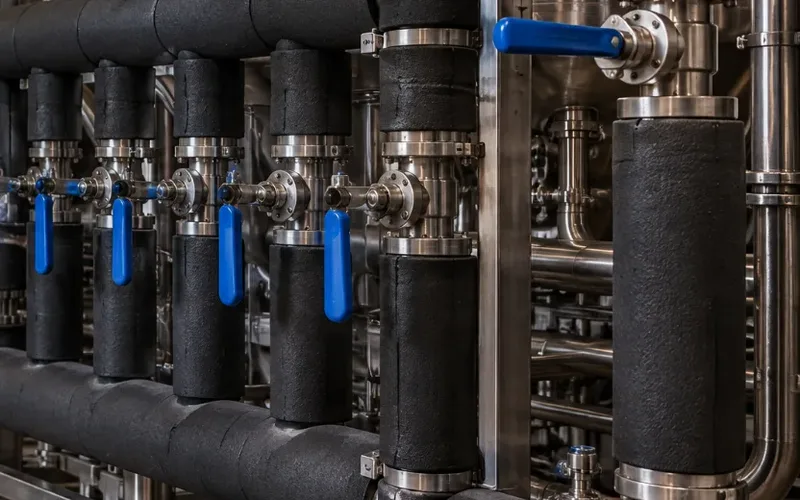
Applications
Sanitary CIP Heaters
The steam-to-solution heater on the skid, its steam trim, and how the tank count changes what it has to do.
+ Learn More
Applications
Industrial CIP
Bigger duties, stronger chemistry, flanged ends and a 400 F rating for cleaning loops that never see food.
+ Learn More
Applications
CIP Return Cooling
What comes back from the circuit at 170 F has to go down the drain at 140 F, and the heat is worth keeping.
+ Learn More