
1-805-484-2992
Quotes - Engineering - SalesOutside the sanitary zone
Industrial CIP heats the cleaning loop for equipment that is not product-contact
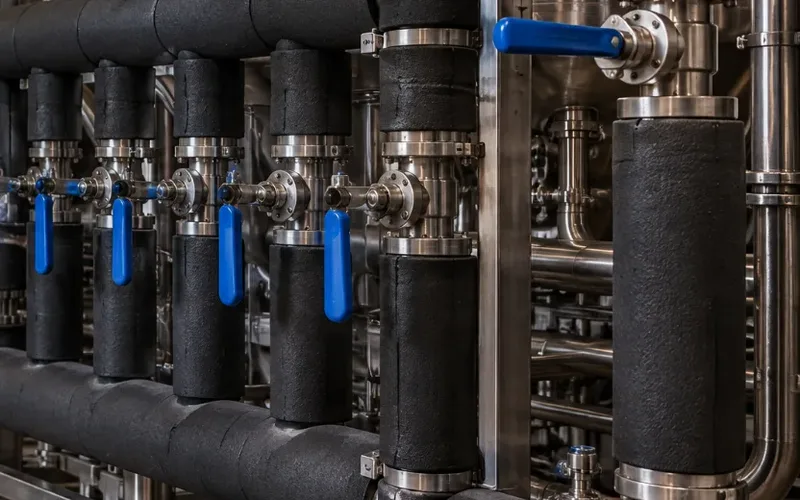
Not every clean-in-place loop in a sanitary plant is sanitary. The utility side of process exchangers, the tank farm, rendering and by-product lines, cosmetics and chemical blending, the pet food kitchen and wastewater pretreatment all get cleaned with hot caustic or acid, and none of it needs 32 Ra or a tri-clamp. The heater on those loops is an industrial CIP exchanger: 316 on the solution side because the chemistry is as strong or stronger, carbon steel or stainless shell, flanged, removable or fixed bundle, rated 250 psig at 400 F so it takes 150 psig plant steam without a reducing station.
The parent page covers sanitary CIP heaters. This page is about the larger, rougher duty: where the loop is switched in, the plate versus shell-and-tube choice at 500 to 2,000 gpm, and what stronger chemistry does to gaskets.
Industrial CIP heaters: duty, geometry and chemistry
How the loop is switched in
At the cleaning window, manual or automated valves close the process loop and open the CIP loop; the CIP pump draws from a solution tank through the heater to the equipment, and the return comes back to the tank or to drain. The heater is sized on the loop flow, set by velocity in the largest line, and on the rise from tank temperature to setpoint in one pass. On a 1,000 gpm loop lifting caustic from 120 F to 190 F that is 35 million Btu/h and a heater with a 6 in steam valve.
Plate or shell-and-tube at this size
A gasketed plate gives the cheapest area on a hot-water-to-solution duty and opens for gasket change, which it will need: EPDM in 5 percent caustic at 190 F lasts two to four years. On steam a plate is limited by its gaskets to about 300 F and by its frame to modest pressure, so above 50 psig steam the heater is a shell-and-tube. A U-tube with steam in the tubes takes 150 psig with no expansion joint and pulls for inspection; a fixed-tubesheet unit is cheaper but needs a shell expansion joint for the 300 degree cycle and cannot be pulled.
The 250 psig, 400 F rating in the standard build covers the steam side without a reducing station and covers the solution side against a CIP pump chosen for a long loop. Code and certification requirements for industrial CIP heaters are set out on our industrial CIP pages.
- Gasketed plate: hot water or steam under 50 psig, up to 2,000 gpm, opens for cleaning
- U-tube shell-and-tube: steam to 150 psig, removable 316 bundle, no expansion joint
- Fixed tubesheet: lowest cost on hot water duties, expansion joint on the shell
Stronger chemistry and what it does
Industrial loops run 3 to 5 percent caustic where a sanitary skid runs 1 to 2, add chlorinated alkaline cleaners for protein and nitric or sulfamic acid for scale, and some lines flush with solvent between campaigns. 316 handles the caustic and acids; chlorinated cleaners at 180 F attack any stainless at crevices, which is the argument for welded tubes over rolled and a drain that empties the shell between cycles. Gaskets are EPDM, or PTFE-lined where solvent is in the program.
The common mistake
A fixed-tubesheet shell-and-tube bought on price for a steam-heated loop with no expansion joint. The first ten cycles are fine. The cycling from 60 F to 350 F on the tubes against a shell that stays at 200 F works the tube-to-tubesheet joints, and by month six the steam side is leaking into the caustic. On steam it is a U-tube bundle or a fixed unit with a shell expansion joint, and HeatX quotes the joint as standard rather than as an option. Call and talk it through with an engineer: 1-805-484-2992


Industrial CIP heater conditions
This is the heavier build for cleaning loops outside the sanitary zone, where the duty and the chemistry are both larger. Set your chemical strength and steam supply against it and send them with the quote request.
| Condition | Detail |
| Fluid | 2 to 5 percent caustic, 1 to 2 percent nitric or phosphoric acid, chlorinated alkaline cleaners, solvent flush on some lines |
| Flow range | 200 to 2,000 gpm; 2 to 20 million Btu/h |
| Temperatures in / out | Ambient or 120 F to 180 to 200 F |
| Hold | 30 to 60 minutes at return temperature; longer on baked-on soils |
| Utility | Plant steam at 50 to 150 psig, or hot water or hot oil loops |
| Approach | Not limiting on steam; 10 degrees on hot water plate duties |
| Construction | Removable-bundle U-tube on steam; fixed tubesheet with expansion joint on hot water; gasketed plate on water-to-solution |
| Finish / class | 316 tubes, tubesheets and channels; carbon steel or 304 shell; flanged 150 or 300 class; mill finish |
| Ratings | 250 psig at 400 F both sides in the standard build |
| CIP / SIP | Self-cleaning by the loop; drained between cycles; no sanitary requirement |
Common FAQs
Because the chemistry is the same or harsher: caustic at 190 F, nitric acid, chlorinated cleaners. 304 tubes pit at the hot end and under deposits within a few years. The shell can be carbon steel where the utility is steam or hot water.
Under about 50 psig steam and 300 F, yes, with EPDM gaskets and a frame rated for it. Above that the gaskets and the frame are the limit and the heater is a shell-and-tube.
250 psig at 400 F both sides in the standard build, flanged 150 or 300 class, ASME stamped. That takes 150 psig plant steam directly and a CIP pump on a long loop.
Yes, for the metal rather than the inspector. Caustic left in a shell between cycles concentrates as it cools and evaporates and attacks the tube joints; a low-point drain and a vent empty it in minutes.
Related
Applications
Sanitary CIP Heaters
The steam-to-solution heater on the skid, its steam trim, and how the tank count changes what it has to do.
+ Learn More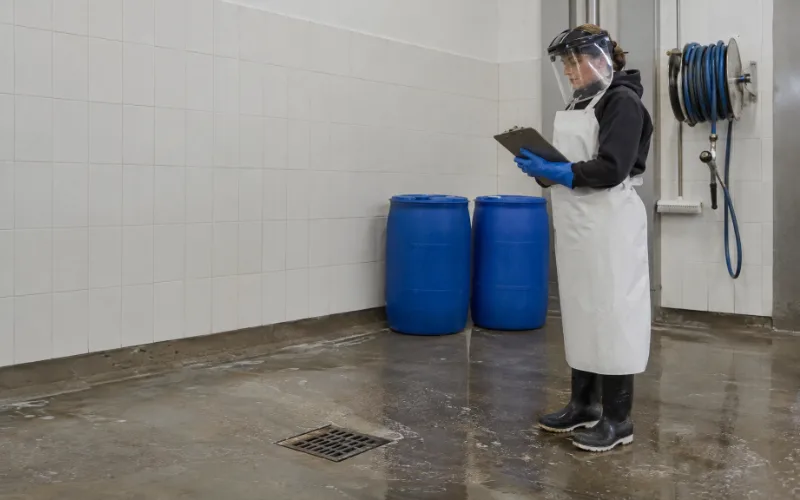
Applications
3-A CIP
Which CIP heaters are product-contact equipment, what the symbol changes, and when it is money wasted.
+ Learn More
Applications
CIP Return Cooling
What comes back from the circuit at 170 F has to go down the drain at 140 F, and the heat is worth keeping.
+ Learn More