
1-805-484-2992
Quotes - Engineering - SalesAfter the hold, and before it
Cooling is half the pasteurizer on an egg line
On a milk pasteurizer the cooler is an afterthought to the regenerator. On an egg line it is half the exchanger, because regeneration is capped at 50 to 75 percent by the wall temperature the raw egg can stand, and everything the regenerator does not recover has to be removed by chilled water and glycol. The product leaves the hold at 134 to 145 F and has to be at 40 F before the tote, bag or dryer feed tank.
There is also a cooler before the pasteurizer: raw egg from the breaker is chilled to 40 F and held there until the line is ready. This page covers both.
Regeneration, chilled water, glycol and the raw side
What the regenerator leaves for the cooler
With regeneration at 65 percent on a whole egg line, pasteurized product at 140 F leaves the regenerator at about 75 F and raw egg enters the heater at about 105 F. The cooler then has 35 degrees to remove, from 75 to 40 F, split between chilled water and glycol. If regeneration is held at 50 percent for a product like salted yolk with a tighter approach, the cooler carries 50 degrees and the glycol section grows by half.
The pasteurized product must stay at a higher pressure than the raw product through the regenerator and into the cooler, and a booster pump interlocked with the flow diversion valve keeps it that way.
Chilled water first, glycol last
Chilled water at 34 to 36 F takes the egg from the regenerator outlet down to about 50 F with a 12 to 15 degree approach, and it does the bulk of the cooling on a utility the plant already has in abundance. Glycol at 26 to 28 F finishes the last 10 degrees to 40 F. Putting glycol on the whole duty is possible but wastes refrigeration and risks a frozen film on the wall at the inlet.
Viscosity is the cold end's problem. Whole egg at 40 F is about twice as viscous as at 140 F and yolk more so, so the glycol section has the lowest coefficient and highest pressure drop on the line. The section is sized at the outlet viscosity with velocity held near 2 ft/s, and on yolk the bore is stepped up in the last pass rather than the pump speed raised.
Raw egg cooling from the breaker
Egg comes off the breaking machine at 60 to 70 F and cannot sit there. A raw cooler on chilled water takes it to 40 F on the way to the raw tank, and it is a duty of its own: unpasteurized egg with shell fragments and membrane that the filter did not catch, through a tube-in-tube at 2 to 3 ft/s so nothing settles, cleaned with the breaking room rather than the pasteurizer.
On a plant that breaks faster than it pasteurizes, the raw tank is the buffer and the raw cooler is sized for the breaker's rate, which is often twice the pasteurizer's.
The common mistake
Finishing on glycol at 20 F to make the cooler smaller. The last pass ices, the outlet creeps to 45 F, and the operator lowers the glycol further. Egg freezes at 28 F; glycol should never be more than 12 degrees below the product outlet. Send the products, the regeneration the line will run, the chilled water and glycol temperatures and the breaker rate if a raw cooler is needed. Call and talk it through with an engineer: 1-805-484-2992




Egg product cooling process conditions
Everything after the hold is set out in the rows: how fast the egg must cool, what it cools against and how the unit is cleaned. Add your product mix and utility temperatures when you send the quote request.
| Condition | Detail |
| Product | Pasteurized whole egg, white, yolk, blends; raw egg from the breaker; 10 to 300 cP at 40 F |
| Flow range | 1,000 to 20,000 lb/h |
| Temperatures in / out | 134 to 145 F from the hold to 40 F; raw 60 to 70 F from the breaker to 40 F |
| Hold | None; minimum time between 120 and 45 F |
| Utility | Regeneration to 50 to 75 percent; chilled water at 34 to 36 F; propylene glycol at 26 to 28 F |
| Approach | 10 degrees regenerator terminal; 8 to 12 degrees glycol to product outlet |
| Construction | Tube-in-tube on whole egg, yolk and blends; wide-gap or double-wall plate on white |
| Finish / class | 316L, 32 Ra; 3-A; solid tube wall or double-wall plate against glycol |
| CIP | In the same circuit as the pasteurizer; caustic, acid, sanitizer every 4 to 8 hours |
Common FAQs
In one pass through the cooler, a matter of minutes, so the product is out of the 45 to 120 F growth range before it reaches the tote. Product held at 60 F in a tank between stages undoes part of the pasteurization.
Both: chilled water at 34 to 36 F to about 50 F, glycol at 26 to 28 F for the last 10 degrees. Glycol alone wastes refrigeration and risks freezing a film at the inlet.
In tube-in-tube construction the solid tube wall is the separation. On a plate cooler for white, a double-wall plate with a vented gap is used where the plant's hazard analysis asks for it, at 10 to 15 percent more area.
Raw egg carries membrane and albumen strands that stick at the inlet, and it has not been through the heater that partly denatures them. It is cleaned on the breaking room's schedule, which is more often.
Related
Applications
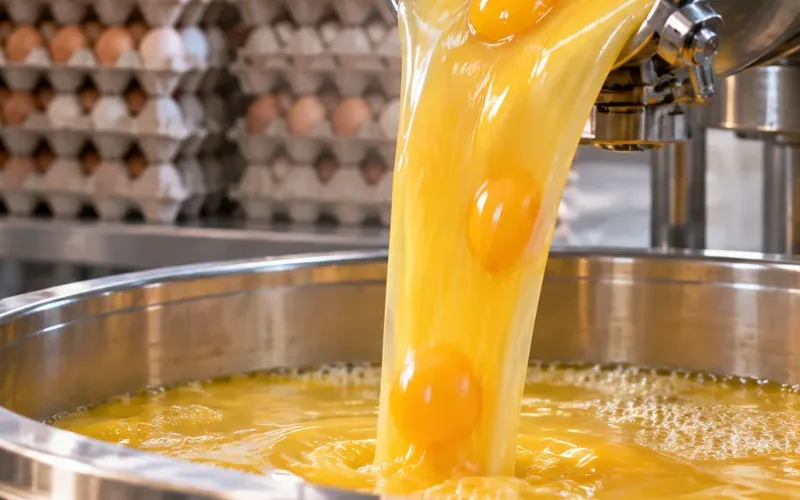
Whole Egg Pasteurization
140 F for 3.5 minutes, with a hot water approach small enough that nothing sets on the wall.
+ Learn More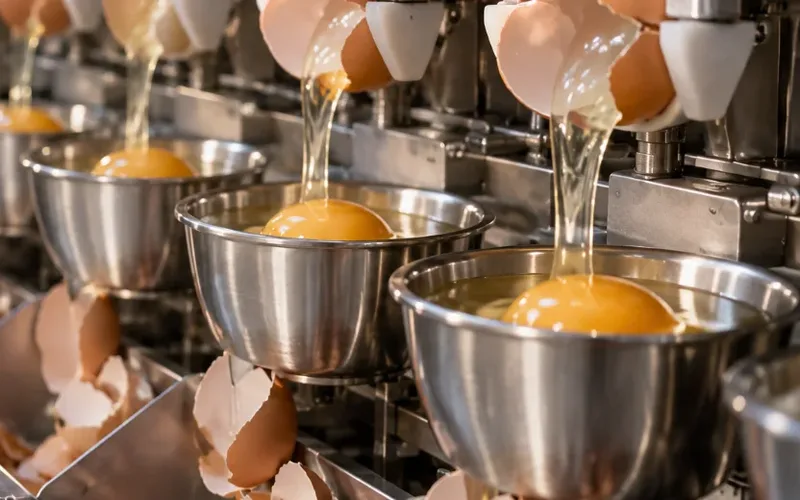
Applications
Egg White & Yolk
The thinnest and the thickest egg products, each with its own temperature and its own exchanger.
+ Learn More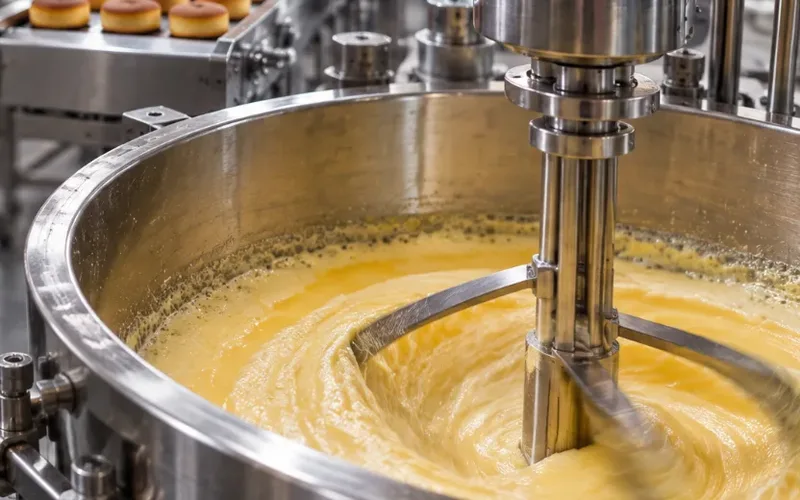
Applications
Egg Mixes & Blends
Egg plus milk, starch, salt, cheese and seasoning: thicker than whole egg and pasteurized a little hotter.
+ Learn More