
1-805-484-2992
Quotes - Engineering - SalesSeparated egg products
White foams, yolk thickens, neither behaves like whole egg
Once the breaker separates the egg, the two streams go opposite ways. Albumen is 10 to 15 cP, whips into foam at the slightest shear and starts to set at 140 F, so it is pasteurized at 134 F for 3.5 minutes and handled gently. Yolk is 100 to 150 cP, tolerant of a little shear, and pasteurized at 142 F, or 145 F once salt or sugar has been added at 10 percent.
This page covers the exchanger for each: wide-gap plates and low-shear pumping for white, large-bore tubes and a tight approach for yolk.
Two products, two exchangers
Egg white: shear is the enemy
Albumen pasteurizes at 134 F, only six degrees below the point at which its ovalbumin begins to set, and it whips into a foam under any turbulence. A foamed product does not fill the holding tube and its residence time is wrong. So the white line is built for the lowest shear in the plant: a rotary lobe or sine pump at low speed, a wide-gap plate exchanger with a 1/4 inch channel and velocity under 1 ft/s, the pack run flooded with a vent at the high point, and long-radius bends everywhere.
Plates suit white because the fluid is thin and regeneration reaches 80 percent at low pressure drop. The hold is not in the plates; it is an external sloped tube cut for 3.5 minutes at the fastest particle, and the hot water for the heater sits at 136 to 137 F, controlled within a degree.
Yolk: viscosity and the tightest approach
Plain yolk at 100 to 150 cP is too thick for a plate pack and runs in a single tube-in-tube with a 1-1/2 to 2 inch bore at 1.5 to 2.5 ft/s. It is pasteurized at 142 F, and the wall is held to 145 to 146 F, because yolk with its high lipoprotein content sets a tenacious film and the film carries yellow specks into the product.
Salted yolk at 10 percent salt and sugared yolk at 10 percent sugar go to 145 F, the highest egg pasteurization temperature, because the additive protects the proteins and the process needs the higher temperature to reach the same kill. Salted yolk at 145 F also pits 304, which is why egg lines are 316L on the product side.
Cooling and the plate-versus-tube split
White comes off the hold at 134 F and is cooled to 40 F on the same plate frame, regeneration then chilled water then glycol, with an 8 degree glycol approach so nothing freezes on the last plate. Yolk comes off at 142 or 145 F and is cooled in tubes; its viscosity roughly doubles between the hold and 40 F, and the glycol section is sized on the cold-end viscosity with a 10 to 12 degree approach.
A plant that runs both products on one skid has to build it as tubes, because tubes handle white at low shear if the velocity is kept down, while a wide-gap plate cannot pass yolk at an acceptable pressure drop. The skid is sized for yolk's viscosity and white's approach, with a setpoint and a hold validation per product.
The common mistake
Running white through a centrifugal pump because it was already on the skid. The pump aerates the product, the holding tube runs half full of foam, the recorder reads 134 F, and the process is out of compliance without an alarm. The positive displacement pump is part of the pasteurizer. Send the products, their flows, the additive on the yolk, and whether one skid has to run both. Call and talk it through with an engineer: 1-805-484-2992




Egg white and yolk process conditions
Egg proteins set close to the hold temperature, so the margins in these rows matter. Compare them with your product mix and pasteurization requirement, and send both so the sizing starts from your numbers.
| Condition | Detail |
| Product | Albumen 10 to 15 cP; plain yolk 100 to 150 cP; salted or sugared yolk to 200 cP |
| Flow range | White 1,000 to 15,000 lb/h; yolk 500 to 8,000 lb/h |
| Temperatures in / out | 40 to 45 F in; white 134 F, yolk 142 F, salted or sugared yolk 145 F at the hold; 40 F out |
| Hold | 3.5 minutes at the product's temperature, fastest particle |
| Utility | Hot water at setpoint plus 2 to 3 degrees; chilled water then glycol on the cooler |
| Approach | 2 to 3 degrees on white; 3 to 4 degrees on yolk |
| Construction | White: wide-gap plate, external holding tube, low-shear pump. Yolk: single tube-in-tube, 1-1/2 to 2 inch bore |
| Finish / class | 316L, 32 Ra or better; 3-A |
| CIP | Caustic at 160 F, acid, sanitizer; white lines 4 to 6 hours between cleanings, yolk 6 to 8 |
Common FAQs
Albumen proteins set at about 140 F, six degrees above the 134 F pasteurization point, and the yolk lipids that protect whole egg are absent. The lower temperature is held for the same 3.5 minutes.
Salt and sugar at 10 percent protect the proteins against heat, so a higher temperature is needed to reach the same kill; 145 F for 3.5 minutes is the standard. The additive also raises viscosity and, in the case of salt, the corrosion risk.
Yes, on a wide-gap pack at low velocity with a low-shear pump and an external holding tube; it is the one egg product that suits plates. Yolk and whole egg run in tubes.
A positive displacement pump at low speed, velocities under 1 ft/s in the plates, flooded operation with a high-point vent, and long-radius bends. Any air entrainment shows as an under-filled holding tube and a failed hold.
Related
Applications
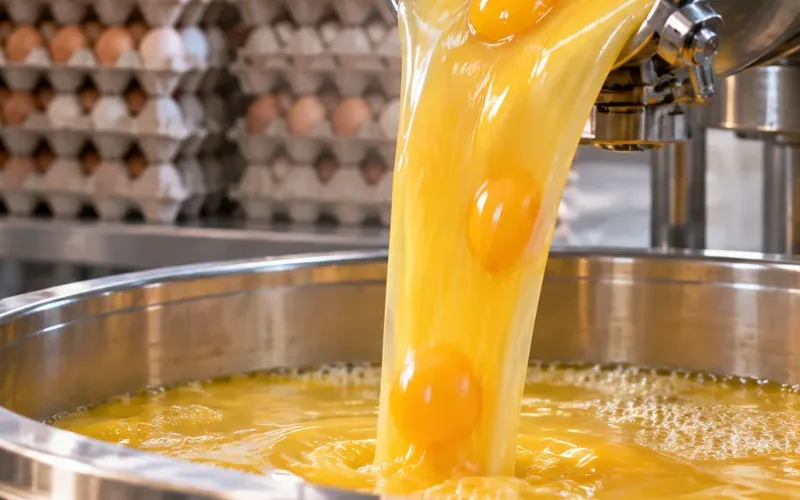
Whole Egg Pasteurization
140 F for 3.5 minutes, with a hot water approach small enough that nothing sets on the wall.
+ Learn More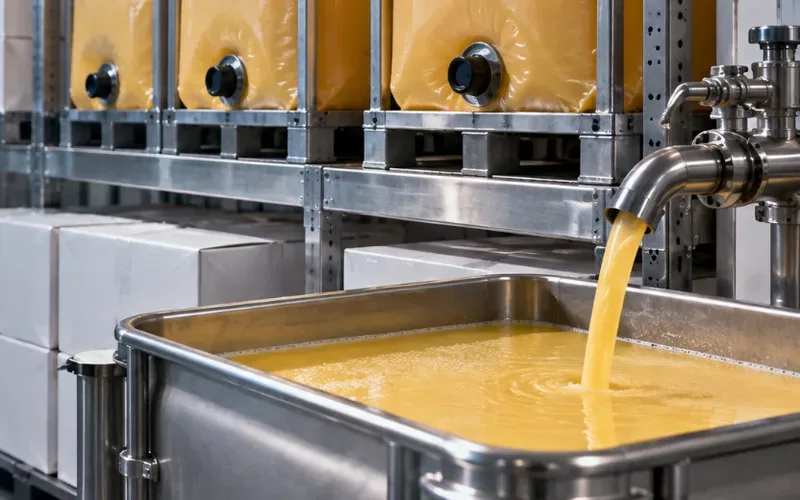
Applications
Egg Product Cooling
The section after the hold, where the egg has to get out of the growth range and down to 40 F in minutes.
+ Learn More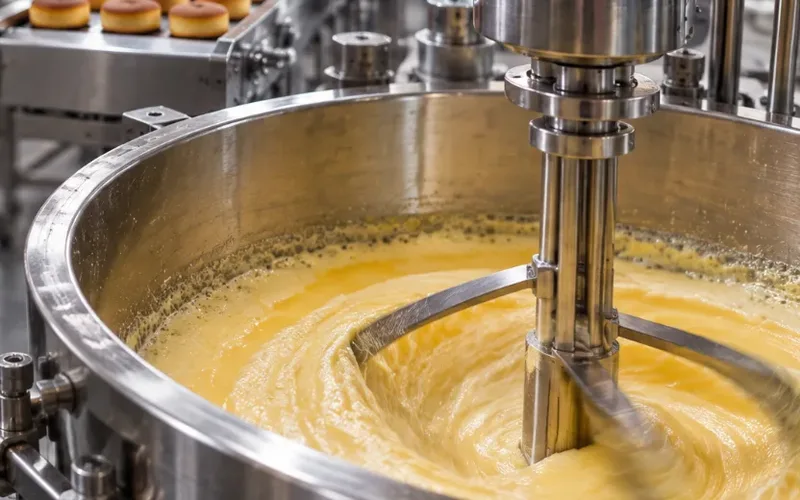
Applications
Egg Mixes & Blends
Egg plus milk, starch, salt, cheese and seasoning: thicker than whole egg and pasteurized a little hotter.
+ Learn More