
1-805-484-2992
Quotes - Engineering - SalesLiquid whole egg, USDA-inspected
The narrowest pasteurization window in food
Liquid whole egg is pasteurized at 140 F for 3.5 minutes. Its proteins begin to denature at about 150 F, and the film against the heating surface is always hotter than the bulk, so the pasteurizer works inside a ten degree band from the moment the product leaves the regenerator until it enters the cooler.
This page is the whole-egg specific part: the approach and the heater length that follow from it, the 3.5 minute holding coil, the limit on regeneration, and the records an inspected plant must show.
Heater, hold, regenerator and records
A heater built on a two to four degree approach
Whole egg reaches the heater at 100 to 120 F from the regenerator and needs to leave at 140 F. Hot water at 142 to 144 F gives a wall the egg tolerates for a shift; at 155 F a film of albumen sets on the tube in the first hour and the diversion valve starts cycling. The 2 to 4 degree approach is fixed, and the duty has to come from area and coefficient.
Corrugated inner tubes give that coefficient. On a 30 to 60 cP fluid at 3 ft/s the corrugation raises the film coefficient 40 to 50 percent over a plain tube without adding the shear that would foam the product. HeatX builds the heater as a multi-pass tube-in-tube with the hot water in counterflow so the last pass, where the egg is closest to 140 F, sees the water at its coolest.
The 3.5 minute holding coil
The holding coil on an egg line is several hundred feet of 1-1/2 or 2 inch sanitary tube, coiled in a frame, sloped to drain and insulated. Whole egg at 140 F is in transitional flow and the fastest particle can move at up to twice the mean, so a coil cut for 3.5 minutes at the mean velocity delivers under two minutes at the fastest particle and fails the process. The coil is cut on a fastest-particle ratio of 2 and validated with a salt or dye pulse at the sealed timing pump's flow.
The timing pump is a positive displacement type with its speed sealed by the inspector; the recording thermometer sits at the coil outlet; and the flow diversion valve returns any egg under 140 F to the raw tank.
Where regeneration has to stop
Egg-to-egg regeneration on a tube-in-tube is worth having, but the pasteurized egg in the annulus is at 140 F and the raw egg in the bore sees that as its wall. Push regeneration past about 75 percent and the terminal approach closes until the raw egg film is at 136 to 138 F for the length of the section, and the regenerator fouls on the raw side, where no one expects it. HeatX sizes egg regenerators for 50 to 75 percent and leaves the last 15 to 25 degrees to the controlled hot water heater.
The pasteurized side runs 1 to 2 psi above the raw side through a booster pump interlocked to the diversion valve, so a leak goes the safe way.
The common mistake
Raising the hot water setpoint to get the outlet back after the heater fouls. It works for twenty minutes, then the fouling accelerates, and by the end of the shift the tube has a cooked layer that has been shedding white specks into the product all afternoon. The fix is more heater length, not more temperature. Send the flow, the breaker temperature, the products beyond whole egg the line will run, and the hot water and chilled utilities. Call and talk it through with an engineer: 1-805-484-2992




Whole egg pasteurization process conditions
The rows below are the pasteurizing conditions we size egg exchangers to, with the build and the records kept. Compare them with your product and send your flow and your required holding time when you request a quote.
| Condition | Detail |
| Product | Liquid whole egg from the breaker, 24 to 25 percent solids, 30 to 60 cP |
| Flow range | 1,500 to 20,000 lb/h; 3 to 40 gpm |
| Temperatures in / out | 40 to 45 F from the breaker; 140 F minimum at the hold; 40 F after the cooler |
| Hold | 3.5 minutes at 140 F at the fastest particle |
| Utility | Hot water at 142 to 144 F, controlled within 1 degree |
| Approach | 2 to 4 degrees on the heater; regeneration limited so the raw side wall stays under 138 F |
| Construction | Corrugated tube-in-tube or multi-tube heater, 1 to 1-1/2 inch bore; sloped holding coil |
| Finish / class | 316L, 32 Ra or better; 3-A; removable inner tube for USDA inspection |
| CIP | Caustic at 160 to 170 F, acid, sanitizer; 6 to 8 hour runs |
| Records | Recording thermometer at the hold outlet, flow diversion valve, timing pump seal |
Common FAQs
142 to 144 F, held within a degree. Every degree of approach above four sets protein on the tube faster, and the heater is sized for that small driving force with corrugated tubes and length.
Around 840 feet at a 2 ft/s mean velocity with a fastest-particle ratio of 2. HeatX cuts it to the length validation demands at the line's sealed flow and builds it sloped and insulated.
Because the raw egg would see a 138 F wall for the whole regenerator and set on it. Egg regenerators stop at 50 to 75 percent; the balance goes on hot water where the wall temperature is controlled.
Yes, with the hot water setpoint changed per product and the holding coil validated once for each. Salted yolk sets the tightest approach and the highest viscosity, so the heater and cooler are sized for it if it is on the schedule.
Related
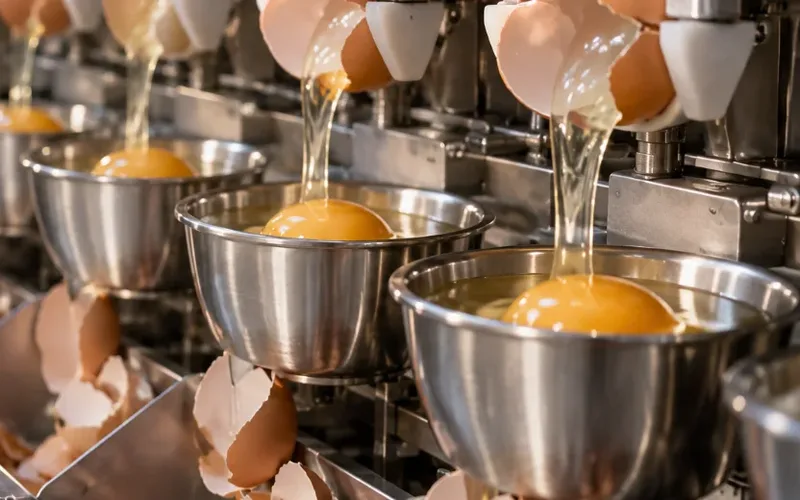
Applications
Egg White & Yolk
The thinnest and the thickest egg products, each with its own temperature and its own exchanger.
+ Learn More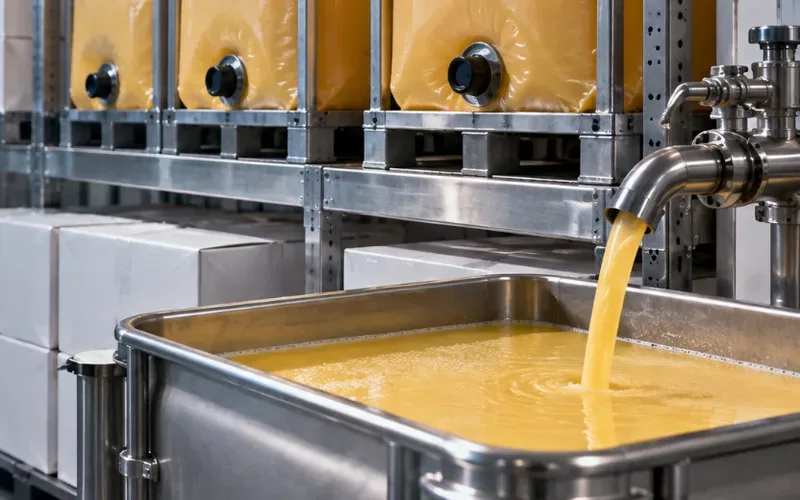
Applications
Egg Product Cooling
The section after the hold, where the egg has to get out of the growth range and down to 40 F in minutes.
+ Learn More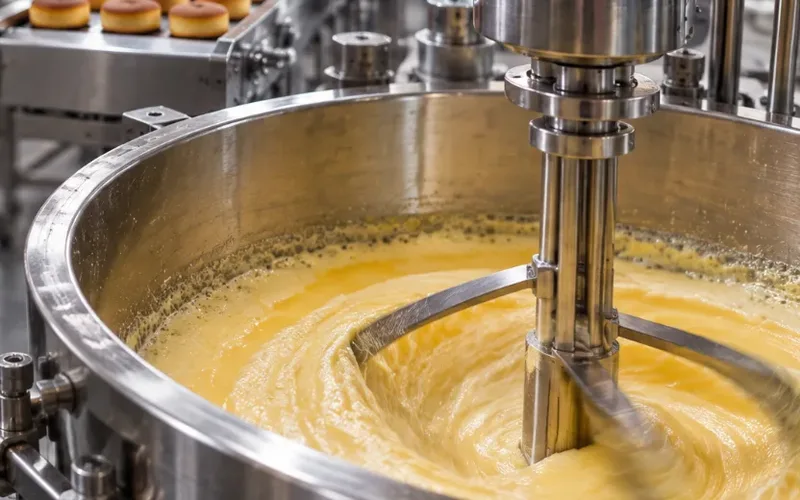
Applications
Egg Mixes & Blends
Egg plus milk, starch, salt, cheese and seasoning: thicker than whole egg and pasteurized a little hotter.
+ Learn More